How do I get started in blogging?
“I want to start blogging, but I don’t know how.”
 Here’s how:
1. Start for free. Invest 0 dollars in the effort. (The time you spend will cost you money anyway.)
You have a variety of free blogging platforms: WordPress.com (which powers this site), Blogger, TypePad, Tumblr, Posterous and many others.
You’ll have to register. You’ll probably need to read the tutorials on these sites, and they have plenty of them to get people started. You can start blogs on all of them, find the one that feels right, and discard the others.
One nice aspect of Posterous: You can e-mail your posts to post@posterous.com, and it will automatically create a blog and post it for you. The subject will be the headline, any attached photos will be added, and any YouTube (or other video site) links will be presented as ready-to-play videos. Try it!
2. Set a goal or two. And write it down. “I want to reach more customers for my business by talking about what we do.” “I want to connect with others who share my interests.” “I want to get better at blogging.” “I want to have an ongoing discussion about product development.”
Whatever your business goals are, define them and commit them to paper (or computer document).
3. Blog now, not later. Commit to it. Set a schedule, and post on that schedule. If you’re ever going to find out if you can sustain a blog, if you’re ever going to try and build an audience, you need to start strong.
Does that mean five posts a day? No. But it does mean that if you commit to two posts a week, you post twice a week in week 1, in week 5 and in week 25.
You will delay until the blog looks perfect, or until you have every aspect of the plan worked out. But to paraphrase an old saying, “Bloggers blog.” Having an empty but pretty site is not blogging.
The payoff for good consistent blogging by investing 0 dollars and an hour a week? Learning more about customer needs. Discovering strengths and weaknesses of your business offerings. Connecting with more fans. Marketing in an interactive fashion.
What challenges are you facing in starting to blog?
Photo by maciekrol.
• • •
Need help with your company blog?
Contact us for a free consultation.
The LinkedIn networking challenge
[See results from the Linkedin networking challenge in 2011.]
Everyone knows LinkedIn is a serious, business-oriented social network. And yet, people are baffled by it.
“I have a profile, but I don’t do anything on LinkedIn.”
“What is LinkedIn good for?”
In March, I began a daily challenge to find out. The LinkedIn networking challenge.
 • The process, part 1: I would contact three connections in LinkedIn every day. To simplify the process, I exported my 500-plus connections into a spreadsheet, adding two more columns. The first column lists the date I contacted that person. The second column has a check mark if that person ever responded.
• The letter: So what do I say when I contact three people each day? I look at their profiles (of course!) and see what they’ve been up to. Not surprisingly, many profiles are thin, little more than a few recent job titles. LinkedIn users may have signed in once or twice, threw together a profile then … let it go. Even worse, they’ve changed jobs and still show their previous job as current. Or leave a primary e-mail address that no longer works.
Oops.
I ask them the same things I would ask them in person or by phone:
- How are you?
- What’s new at work? At home?
That’s it, basic networking. No sales pitch. Really, nothing about me. (Heck, my super-snazzy multimedia LinkedIn profile will tell them what they need to know. Literally.)
• The process, part 2: Some responded through LinkedIn. Some responded via e-mail. Some never responded. But I followed up with every single person who replied. (I also marked that they replied in my spreadsheet.)
Many politely asked about me: How’s work? What do I do? How am I doing? Naturally, I talked about my job, my projects and my busy, busy life. Again, no sales pitch needed. It’s important that I share what I do and how much I love it. It’s also important for me to offer ideas, tips and questions to see if their business needs help.
I’m here to learn. I’m here to listen. And I’m here to help.
 • The results: I thought maybe a third might respond to my LinkedIn e-mails. I was wrong.
More than 61 percent have replied, usually within a day or two (though some let those e-mails sit around for up to 2 months).
It has not resulted in new work. Yet. But I have learned a lot about my friends on LinkedIn. New jobs, new duties, new cities, new babies. Perhaps the most shocking was learning about a friend whose wife is about to have an operation to remove a brain tumor. He detailed the strain it has put on his family, yet maintained a positive outlook in the tone of his message.
How grateful I am that he shared his update with me. He could’ve skipped the reply: Certainly, he has far more important things to tend to. Or he could’ve replied with the pleasant exchanges we do so well in the South.
And yet, he went above and beyond. It has been an eye-opening conversation.
• The lessons so far: By spending about 20 minutes a day writing and replying to LinkedIn contacts, I am deepening my connections with my friends. (And I don’t let any strangers into my LinkedIn network. If we haven’t met in person, you can’t come in.) I wouldn’t try to have strictly business conversations through my Facebook profile. But I’ll gladly start the ball rolling in LinkedIn.
And as I’ve made a habit of checking in on LinkedIn each day, I add more trusted friends to my network. By the time I’m done with my first round of LinkedIn e-mails (sometime in the fall), I’ll have added at least a couple hundred more connections. So I’ll start from the beginning of the list and e-mail again, focusing on those who replied and those who are new.
By figuring out where my network is most responsive, I can concentrate future efforts on that core group. No one gets dropped as a connection because they don’t respond to me, but now I can spend time working with those folks who want to discuss business challenges and solutions.
By spending time each day reconnecting with people on LinkedIn, I’m planting the seeds today for future opportunities.
That is deliberate, personal, business-oriented, serious, hands-on networking.
How are you using LinkedIn to build your business?
Photos by smi23le.
• • •
Need help with your company’s social media?
Contact us for a free consultation.
Don’t let your Facebook page die – interact with it
This column originally ran in “The Idea Corner” in the April 2 print edition of the Birmingham Business Journal.
 Facebook is no longer that social networking site for kids. It passed Google in March for front page visits. It has more than 400 million active users, making it the third largest “country” in the world.
And yet, your company has no presence on it. Or worse, it started a fan page months ago, only to let it die a slow public death.
What went wrong?
1. Facebook is a gigantic community, and you became lost in it. No one knew you had a fan page, and even your own fans forgot that they had joined it some time ago.
You forgot that you’re a tiny pebble in an ever-growing ocean. That’s not a problem; that’s an opportunity, but only if you make it happen.
2. Your fan page was the goal, not the medium. Putting up a fan page on Facebook is like installing a phone line. Congratulations: You now have the most basic component of communication on your desk that will do absolutely nothing by itself.
The phone is for you to call prospective customers, order supplies, schedule meetings, buy advertising, answer questions and connect with the world at large. What can you do with your fan page?
3. Your fan page is all about you, not your fans. Sure, fan page implies it’s about the company that set it up: your brand, your new products, your crazy giveaways. But in the world of social media, it’s really about them, the loyal Facebook users who might stop by your page if you’re lucky.
You may have spent a lot of time talking about your company and not with fans. You went for the easy sell over the long-term engagement. And you pushed away the very people who tried to embrace you publicly.
How should we fix our Facebook fan page?
1. Know your place. You are but one of hundreds of thousands of fan pages vying for time and attention. You can stand out with good updates and interaction, which we’ll discuss below. You can stand out with consistent marketing. That’s right: You not only need to market your company, your Web site and your products, but also your Facebook page.
One way to make it easier: After you pull in at least 25 fans, customize the link. For example: facebook.com/acme.
2. Know your real goal. Your company’s goal shouldn’t be “Set up a Facebook fan page.” It should be something like “Use Facebook to reach potential customers on an ongoing basis,” or “Understand and solve customers’ needs and complaints through interaction on Facebook fan page.”
Setting up a page is easy. It takes 10 minutes and zero strategy. Executing a business-building strategy with social media takes specific measurable outcomes, time and persistence. Remember: Your phone is a tool; use it to make your company grow. Your Facebook fan page is a tool, too. Use it.
3. Know your fans. That means every interaction is about them, not you. Every update is designed to brighten their day, solve their issue or hear them out. Your Web site does a fine job of product brochure; does your Facebook page need to duplicate that function?
Make sure you invite your fans to speak their mind. (Your phone accepts calls, not just places them, right?) And absolutely answer them when they take time to comment. (If you don’t answer the phone, why do you have one?)
Strip away sales pitches and see if you have anything left to say. If not, you have a much bigger problem than your Facebook image.
A company with a good product and tight focus could even get away with having just a Facebook fan page in lieu of an independent Web site. But only if it knows how to be neighborly in the world’s largest social media country.
• • •
• • •
Need help with your company’s social media?
Contact us for a free consultation.
Fix Your Facebook – notes and more
Notes from my “Fix Your Facebook” seminar at Innovation Depot.
Possible problems with your company’s Facebook page
- It’s lost among the millions of other pages.
- Your fan page became the goal rather than the channel.
- Your fan page is focused on you and not your fans.
Solutions
- Know your place in the Facebook universe.
- Post regular status updates.
- Market your Facebook page.
- Let’s have conversations about _______ .
- Know your goal.
- Fans?
- Site traffic?
- Research?
- Sales?
- Promotions?
- Customer service?
- Our goal on Facebook is to _______ .
- Know your fans
- How can you solve a problem for them?
- Listen to their complaint?
- Brighten their day?
Bonus tips
- At 25+ fans, set your page’s vanity URL at facebook.com/username/.
- That little box in the upper left helps your SEO.
- Use @mentions to highlight fans, sneak onto their walls.
- Your age restrictions determine your visibility on Google and to non-Facebook users.
- You can link to specific tabs on your fan page, even create a custom landing tab.
Also
- Download the cheat sheet [pdf]
- Original column: “Don’t let your Facebook page die – interact with it”
(More to be added.)
• • •
• • •
Need help with your company’s social media?
Contact us for a free consultation.
Fix Your Facebook free seminar
 I’m happy to announce that I’ll be giving a lunchtime talk, Fix Your Facebook, at Innovation Depot on Wednesday. We’ll talk about making the most of your company’s Facebook page.
It’s open to the public, but limited to 40 attendees. The seminar runs from noon to 1 p.m. at the Depot, 1500 First Ave. N. [map], and is BYOL, bring your own lunch.
To reserve your spot, you’ll need to visit the event on Facebook (of course) and tell me you’re coming.
My thanks to business incubator Innovation Depot for sponsoring the event.
Questions about Facebook? Leave one in the comments!
• • •
More free Facebook advice on the BBA blog.
How to conquer Ignite Karaoke

The first Ignite Birmingham went brilliantly, with a terrific lineup of speakers and topics. I loved having the chance to be a part of it, even if I didn’t do a formal presentation.
Instead, I volunteered for Ignite Karaoke, which challenges the speaker to talk for 5 minutes about one topic. I had to use 20 slides, advancing one by one every 15 seconds, that I hadn’t seen before.
Needless to say, I was sweating a bit.
But I had fun with it, and I think the audience did, too.
We’re very excited about holding another Ignite, probably in August. Several people have already stepped forward to speak at the next event, and a few were leaning toward Karaoke. Yay!
Allow me to share my tips on how to conquer Ignite Karaoke, because, believe me, anyone can do it.
1. Give talks, lectures and presentations. A lot. If you want to become a better public speaker, you actually have to do it often. Some folks are afraid of speaking before a group of people, but you can get better with each outing.
Speaking in front of an audience frequently teaches you how to make eye contact, how to pace yourself, how to pause, how to move away from the podium, how to improvise (especially when things go wrong). You learn to be the center of attention without wilting or falling apart.
2. Do not panic. Do not even show panic. The first slide in my deck, which sets the topic, was labeled “sociosemantics.” It took me a moment just to find it on the slide (it was superimposed over a busy background photo). “Oh sweet heavens,” I thought, “What is sociosemantics??”
I laughed. There, I just gave you my tell. And then I began weaving together a talk on what I know: the meaning of language and how it impacts society.
Take a deep breath and plunge ahead.
3. Do not read the slides aloud. This is a grand temptation for any impromptu speaker. You see words on a slide you’ve never seen before, and you want to read it aloud to get it fixed in your mind. Don’t. Your audience can read it just fine.
Instead, focus on what the slide means in your overall presentation. Transition as naturally as you can from your previous talking point. Sometimes, you’ll end up making a point for every slide. That’s OK.
4. Speak with confidence. A voice of authority goes a long way in winning over your audience. It says, “I know where I’m going; feel free to come along with me.” In my 5 minutes, I didn’t have a moment where I didn’t speak clearly, loudly and authoritatively about the meaning of language. I made eye contact, I planted my feet, I used my hands to emphasize points.
That confidence comes from years of practice, including 25 years of impromptu speaking.
A couple of speakers ahead of me were concerned they would somehow end up with the impromptu deck, that they would be forced at gunpoint to talk off the cuff. I found that odd. Impromptu is how you speak most of the time. It’s prepared talks that usually make you sound forced and unnatural.
5. When you do prepared talks, use notes instead of a script. The key to sounding prepared but not over-rehearsed? Use as few notes as possible. Use a broad outline, or a few talking points, but do not have a word-for-word script to read aloud.
This doesn’t mean skipping rehearsal. You can tell immediately who has practiced, and who’s winging it. You owe it to your audience to work out most of the kinks ahead of time. This includes pacing yourself, allowing enough time for questions, avoiding rushing or skipping over important points. Author Tim Ferriss breaks it down into segments for preparation and rehearsal.
You, too, can conquer Ignite Karaoke. Sometimes, it comes down to the slides. You get a great deck, and your talk will flow effortlessly. You get a lousy shuffle, and it will seem like the longest 5 minutes of your life.
But if you’re having fun, your audience will, too. Go for it!
Photo by Henry McBride
• • •
More updates and info for free …
Sign up for our e-newsletter today!
Settin’ the words on fire: Speaking at Ignite Birmingham
In a week, I’ll be onstage giving a 5-minute presentation. No big deal: I give presentations and talks all the time.
 Except …
This is the first Ignite Birmingham. And while the other speakers will be using prepared presentations and automated slides, my talk will be off the cuff. Twenty random slides, which I will not have seen beforehand, will guide my impromptu presentation.
Welcome to Ignite Karaoke.
I’m very excited. To the point that it’ll seamlessly blend into nerves. Many, many nerves.
Ignite is new to Birmingham. It’s a global phenomenon based on a simple format: Bring together great thinkers from your city, have them talk for no more than 5 minutes on their idea or their passion. They can use up to 20 slides if they wish, but each slide auto-forwards after 15 seconds.
This free event gives communities a chance to feast on new ideas and converse with thinkers and shakers.
I’ve never been, and I’m really looking forward to hearing our speakers blow. our. minds.
If that weren’t enough, we’re also having Ignite Karaoke. My friend Tom Brander and I will each take a turn talking for 5 minutes with that crazy set of slides.
On the plus side: no preparation! Yay, laziness.
On the minus side: It could crash and burn spectacularly. (For some of you, that will be a plus.)
You can help!
Our organizer Henry McBride wants to include your slides. He’s looking more for pictures than words. You can e-mail your slides to ignitebham@gmail.com.
Be creative! Be crazy! Be challenging! The slides you send in will determine how Tom and I do. We’ll be your Ignite puppets.
I promise it’ll be fun and fearless. Hope you can join us.
The first Ignite Birmingham takes place at 6 p.m. April 22 at UAB’s Lister Hill Library [map]. Tickets are sold out, but visit the registration page to join the waiting list.
All about Ignite Birmingham:
- Official site
- Twitter: @IgniteBham
Additional coverage:
 I’m pleased to announce that I’ll be a featured speaker at BlogWorld and New Media Expo 2010 in October in Las Vegas. This marks my second year as a presenter at one of the world’s largest social media conferences.
I found out by e-mail Tuesday from Nikki Katz, the event’s new managing blog editor. She has been asking a select few (or perhaps, a select many) to contribute to the BlogWorld official blog in the coming months.
I’m excited and now overwhelmed with new assignments …
- Develop a topic for this year that will be insightful, helpful and fun.
- Write a post or two for the BlogWorld blog.
- Add one or two more follow-up posts to the 2009 aftermath.
- Work on recruiting more Birmingham professionals to attend through my mini-blog, Birmingham to BlogWorld.
Whew. And buy plane tickets, reserve a room, all that jazz.
Six months to go, and I can hear the clock ticking louder and louder …
Can’t wait!
Come with me: You’ll have a terrific time.
• • •
More updates and info for free …
Sign up for our e-newsletter today!
Your secret bonus Twitter followers
I’ve been on Twitter as @WadeOnTweets for a little more than a year and have pulled in 1,849 followers. Not bad for 10,000 tweets and counting.
But beyond my regular followers, I also have a secondary group of fans following my microblogging, thanks to Twitter lists. These lists allow users to organize Twitterers they’d like to track, even if they’re not following them directly.

Twitter lists featuring @WadeOnTweets.
So let me trot out a few numbers …
- @WadeOnTweets is on 137 lists;
- 679 Twitterers are following those lists (yes, I counted);
- That’s an average of 5 followers per list.
In essence, I have more than 2,500 followers on Twitter when you add in the all those list audiences.
Why am I listed so frequently?
- I share good info.
- I tweet regularly.
- I fit into a number of categories: media, Birmingham, social media, conversation, blogging, writing, etc.
Even among the few lists I’ve created, the numbers are notable …
- I’ve created 7 lists;
- 43 Twitterers are following them;
- That’s an average of 6 followers per list.
Don’t get too caught up in the numbers game, but do understand how far your message can travel. By being a good Twitterer and attracting the followers who show you off in their lists, you can reach many more people. In my case, I’m reaching 37 percent more people thanks to Twitter lists.
That means 679 more people who can click my links, retweet my ideas and reply to me.
(And that’s not even counting when those Twitter lists are embedded on Web sites …)
Are you getting listed? Are you making lists?
• • •
Also:
- “My first year of tweeting: the best microblogging”
- “Character study: My first 10,000 tweets”
- “How I’m using Twitter lists”
• • •
More updates and info for free …
Sign up for our e-newsletter today!
How you’ll blog using the iPad
Tablet computers will change how we share information

Typing on the iPad: The future of blogging?
Coming Saturday, the iPad. Will it revolutionize how we consume publications? Or change the face of computing?
Will it even work as promised?
All we know at this point is that Apple has done a masterful sales job, as it appears the initial inventory has already sold out. And whether it succeeds or fails, the iPad will likely leave an indelible mark on how we take in, process and publish information.
Based on what I know — I haven’t held or tested the iPad, just my handy iPhone — here’s how I see us blogging in the near future using the iPad.
Blog from anywhere
For starters, you’ll be able to blog from anywhere. At least, anywhere you have a 3G signal, and only if you pay more for the iPad with 3G. That means a significant expansion of territory for most of us.
Sure, wi-fi is a great option, but as someone who travels a lot for business, wi-fi is often weak, expensive or nonexistent. I always have my aircard, which allows me to be online anywhere within 3G territory. A lot has been made of AT&T’s coverage, but the real question will be: When all of these iPad users flood the network, will any of us be able to get online?
Photos will cost you
The iPad has no built-in camera, but Apple will be happy to sell you a camera connection kit for $29. In essence, this pricey cable will allow you to pull photos from your digital camera. Your alternative: Send your photos from your camera to your favorite online storage site (like Flickr) ahead of time, or transmit them from your phone.
Naturally, this will not affect the millions of bloggers who steal images for their posts in violation of copyright law.
Long posts will cost you, too
You might be proficient at typing on the full-size touch keyboard. Like the iPhone, the software will anticipate your intended spelling and formatting, as seen in this preview video of the Pages app for iPad.
Video: Demonstration of Pages app in iPad
But if you require a real keyboard like me, Apple will be happy to sell you a keyboard dock for $69. Or you can purchase a bluetooth keyboard starting at $20. Unfortunately, that means lugging around more gear, when the idea of the iPad is one thin, light piece of equipment. Those blogging on deadline may need to invest in the reliable clickety-clack keyboard to type faster.
It will be mostly seamless
I use WordPress, but on my iPhone, I have to use special techniques to blog. I can e-mail an entry. I can see a special mobile version of the administration panel. Or I can use the WordPress iPhone app.
Those methods have their drawbacks.
But on the large screen of the iPad, I can likely log into WordPress through Safari and do just about anything I could from my laptop.
Be warned: Posterous uses a lot of Flash. The iPad, however, doesn’t do Flash. Which means you won’t be able to use the Posterous Web interface. You can still e-mail in your posts, which is Posterous’ strength.
We’ll likely see new versions of the WordPress, Blogger and Typepad apps that play to the iPad’s strengths: bigger screen, location-aware sensor, drag-and-drop editing, more accurate previews of the final post.
More blogging in the moment
I love my laptop, but the battery life is terrible. If I want to blog “in the field,” I’d better have my power adapter, and I’d better be within 4 feet of an outlet.
The iPad claims to last 10 hours between charges. That would allow you to pull out the iPad in class, at a restaurant or at a conference and blog in the moment. Live results, live commentary, live interaction with readers.
After a great (or terrible) meal at a restaurant, you might drop a couple of notes into Yelp. Would you pull out an iPad and start writing about the experience on the spot? Maybe not at the table, but someplace afterward before heading home.
Or as you head down the highway for summer vacation, you’ll keep a rolling travelogue. Yes, from the passenger seat; don’t blog and drive, kids.
Or as you talk with customers at their offices, you take their product questions and turn them into the Q&A of the day for your company blog.
•
I’m writing this post from my laptop in my home office. In a couple of years, I might be blogging more and more from a tablet, unshackled from a desk, a power outlet and yes, even a real keyboard.
Whether the iPad lives up to the considerable hype may not matter. For bloggers on the go, the iPad and successor tablet computers will mean better posts, more options and more interaction wherever they are.
•
Will you invest in an iPad? How would you use it for blogging?
•
More on blogging:
Sneak peek: Facebook column for Birmingham Business Journal
To follow up my January column in the Birmingham Business Journal, I’ve written a how-to on making your company Facebook fan page more effective. Here’s a sneak peek:
THE IDEA CORNER
What Facebook can mean for your company
Facebook is no longer that social networking site for kids. It passed Google in March for front page visits. It has more than 400 million active users, making it the third largest “country” in the world.
And yet, your company has no presence on it. Or worse, it started a fan page months ago, only to let it die a slow public death.
What went wrong?
- Facebook is a gigantic community, and you became lost in it. No one knew you had a fan page, and even your own fans forgot that they had joined it some time ago.
You forgot that you’re a tiny pebble in an ever-growing ocean. That’s not a problem; that’s an opportunity, but only if you make it happen. - Your fan page was the goal, not the medium. Putting up a fan page on Facebook is like installing a phone line. Congratulations: You now have the most basic component of communication on your desk that will do absolutely nothing by itself.
The phone is for you to call prospective customers, order supplies, schedule meetings, buy advertising, answer questions and connect with the world at large. What can you do with your fan page? - Your fan page is all about you, not your fans. Sure, fan page implies it’s about the company that set it up: your brand, your new products, your crazy giveaways. But in the world of social media, it’s really about them, the loyal Facebook users who might stop by your page if you’re lucky.
We’ll alert you when the column appears so you can pick up a copy at the newsstand!
• • •
Need help with your company’s social media?
Contact us for a free consultation.
Be bold: Embrace social media
This column originally ran in “The Idea Corner” in the Jan. 22 print edition of the Birmingham Business Journal.
When I hear from business owners, they ask great questions about social media, namely “What’s in it for me?”
They don’t know why they need to waste time on setting up a Facebook account or learning how to tweet.
What are you afraid of?
I didn’t get on Twitter until February 2009. I thought it was silly. I didn’t get it. I was afraid it would eat up too much time.
But I volunteered to talk about social media tools for a Birmingham Regional Chamber of Commerce seminar. Oops. Looks like I needed to learn the ins and outs of Twitter in 30 days.
I went in with a game plan and a willingness to learn. If it turned out to be useful after 30 days, I’d keep tweeting. If it turned out to be a time drain and a bore, I’d drop it.
I conquered my fear by taking one small step after another. Set a goal to learn. Then, sign up for an account. Begin to watch how others use the tool in different ways.
Next, send status updates about me, my work and my life. And finally, talk with people. Real conversations in real time that weren’t dumb old sales pitches.
That doesn’t sound so difficult, does it?
Let’s name some fears people have when it comes to social media. By saying them aloud, we diminish them.
• Fear of looking foolish: Few people want to come off as silly or unserious when it comes to their brand or their company.
But making mistakes is a part of social media and a part of being human. What I hear clients telling me is, “I’m afraid of being human.” Too late: It’s a life sentence. Embrace your imperfection, and people will embrace your humanity.
• Fear of wasted resources: Who wants to waste months and dollars on a project, only to see it go nowhere? That’s a great fear to have. If only more companies were as judicious with resources and making the most with what’s available.
Social media should be no different. Every new endeavor should have clearly defined goals with measurable results and flexible execution. Can social media help your business? Make a plan and find out.
• Fear of not jumping in: Some business owners can hold onto two opposing fears at once: fear of using social media and fear of not getting on the bandwagon. The good news is that Facebook has 300 million users and won’t be going away anytime soon. If your business decides to wait 6 to 12 months, Facebook and other social networking sites will still be around.
Same with blogging. Recently, Technorati State of the Blogosphere reported, “The rise of the professional blogger continues: 70 percent of part-timers, pros and self-employeds are blogging more than ever.” Holding on to these two opposing fears can be paralyzing. Let them both go.
• Fear of negative feedback: When customers complain about your company — and most of us complain — they are giving you an opportunity to be a hero or a coward. Heroes run into burning buildings with little regard for their own safety. Cowards run away.
By learning why your customers are unsatisfied and finding ways to turn it around, your company can act heroically. No, you won’t and can’t “save” everyone, but your reputation will soar far above your competitors.
• Fear of failure: This is the big one. Your company might look foolish. Or waste time trying to figure out these tools. Or not jump in soon enough. Or miss hearing critical comments from customers.
Psst, your company is probably already failing at these things. We all struggle with learning in this new social economy and will fail many times. The better question is: Are we learning from our mistakes? Are we getting better with each conversation?
After 30 days on Twitter, I gave my talk to a lively audience. And I still tweet every day. As a writer, it gives me a new outlet for precious words but also gives me flashes of insight on the human condition.
And in business, it allows me to push fear aside and dive head first into the global conversation. Afraid? Not me.
• • •
Need help with your company’s social media?
Contact us for a free consultation.
March 2010 media release
FOR IMMEDIATE RELEASE
March 17, 2010
Wade Kwon
mail[at]birminghamblogging.com
BIRMINGHAM BLOGGING ACADEMY AND INFOMEDIA
PARTNER FOR NEW TRAINING PROGRAM
BIRMINGHAM, Ala. — Birmingham’s oldest and newest Internet companies have teamed up for an innovative training program.
Web site developer and marketing firm Infomedia, formed in 1994, and the Birmingham Blogging Academy, formed in 2009, will offer new blogging options for corporate Web sites, including design, development and training.
“Blogging gives businesses a cost-efficient marketing edge,” says Infomedia president Jason Lovoy. ‘The best-performing sites enable a natural flow of communication that builds business.”
“We want to show business owners how to make the most of their online presence to connect with customers,” says Wade Kwon, founder of the Birmingham Blogging Academy.
The four-hour course will show attendees how to set goals for their sites, develop content and promote it. Infomedia provides custom Web sites and interactive marketing tools — including blogs — for businesses from startups to Fortune 500 companies.
Monthly classes are scheduled to start in May at Infomedia exclusively for its clients.
For more information on classes, visit infomedia.com or birminghamblogging.com.
Wade Kwon is available for interviews to discuss how businesses can use blogs to market their products and services. Contact him at mail[at]birminghamblogging.com.
– 30 –
Be careful chatting on Facebook
I had a chat with a friend of mine on Facebook this morning. Well, until I realized I was chatting with a hacker who had hijacked her account.
So I decided to have a little fun.
Some words of advice to avoid online fraud and phishing:
- Use a secure password for Facebook and other social media sites. Change them regularly.
- If someone contacts you through Facebook chat and asks for something, be very suspicious.
- Contact them through an alternate channel (phone, e-mail) to verify.
- Have them change their password and alert Facebook’s customer service.
See below for the full transcript.
(I set up Facebook chat through iChat for convenience.)
Update: TechCrunch posted on this particular scam more than a year ago.


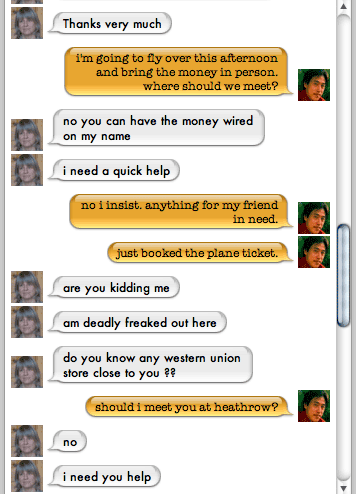


Jabber IM with <“Friend”>
3/10/10 9:30 AM
“Friend”: hello
“Friend”: how you doing ??
Wade: good morning. I’m doing fine. How about you, [Friend]?
“Friend”: am not too good
“Friend”: am in kind of terrible shit at the moment
Wade: Sorry to hear that. What’s going on?
“Friend”: am stuck in london
“Friend”: I had to visit a resort on short vac but got mugged at a gun point
Wade: Oh my.
Wade: I assume your papers were stolen.
“Friend”: All cash cc and my wallet were stolen off me by the muggers
“Friend”: Thank god am left with my passport
“Friend”: am freaked out here
“Friend”: i need your help pls
Wade: What help do you need?
“Friend”: Our return flight leaves in 2 hours time but i need some cash to sort the hotel and to get a cab to the airport
Wade: and how much cash do you need?
“Friend”: 920
“Friend”: will def refund you back as soon as am back tomorrow… I promise
Wade: did you talk with carrie at the office?
“Friend”: i lost all contact
“Friend”: should i send you my info you need when you get to the western union ??
“Friend”: Thanks very much
Wade: i’m going to fly over this afternoon and bring the money in person. where should we meet?
“Friend”: no you can have the money wired on my name
“Friend”: i need a quick help
Wade: no i insist. anything for my friend in need.
Wade: just booked the plane ticket.
“Friend”: are you kidding me
“Friend”: am deadly freaked out here
“Friend”: do you know any western union store close to you ??
Wade: should i meet you at heathrow?
“Friend”: no
“Friend”: i need you help
Wade: are you at gatwick?
“Friend”: you can have the money wired to my name Via western union store close to you
“Friend”: am in local library 2 block to the hotel
Wade: ok i’ll be there in about 10 hours.
Wade: hang tight!
“Friend”: our return flight leaves in 2 hours time
Wade: don’t worry, i’ll be there soon.
Wade: i need to pack and find my passport.
Wade: do you want me to bring your cat?
Wade: ok i’ll bring your cat.
“Friend”: just joking
“Friend”: just pulling your leg
Wade: i’ll see you tonight.
“Friend”: ok
Wade: And when I see you, hacker, I’m going to rip your limbs off.
“Friend”: your fathere
Wade: goodbye, hacker. burn in hell.
“Friend” is now offline.
How do I handle two topics for best site SEO?
 Before our March 6 class, “How to Reach Your Traffic Goals with Search Engine Optimization (SEO),” we’ve asked you for your SEO questions to answer on the blog.
Trav at head:subhead asks: “My blog bounces between two main topics: digital publishing and book events in Birmingham. But both have books at the core.
“Are these two areas too diverse to be on the same site? Am I diluting any SEO-friendly content? Should I have two separate sites?”

Instructor Jen Barnett responds:
Looking at your blog, a more important question to me: Is your blog for authors, for book industry professionals or for readers? Which are you?
Your tagline says “all things book,” but that seems like it would take more than one person — even if you’re glued to your keyboard — to cover all things book.
You have two main but divergent strategies:
- Actually become all things book, and divide your site into subcategories for authors, readers, bookstores, literary events and signings, digital books and technology and so on. This would be a huge project but could be super-profitable. Your SEO strategy would include keywords for everything to do with books. (You’d probably need more writers).
- Divide into two blogs, like you suggested. Digital publishing is a global topic for authors, developers and the book industry. Book events is a blog for local folks who love to read.
Fine-tune your content strategy, and SEO will come naturally.
• • •
Have a question? Leave it as a comment on our intro post.
• • •
Want a custom SEO plan for your site? Register today for our March 6 class.
February 2010 media release
FOR IMMEDIATE RELEASE
Feb. 22, 2010
Wade Kwon
mail[at]birminghamblogging.com
BIRMINGHAM BLOGGING ACADEMY TEACHES
HOW TO BUILD WEB SITE TRAFFIC
BIRMINGHAM, Ala. — It seems like everyone has a Web site these days, but no one knows quite what to do with it. A new class at Birmingham Blogging Academy will show businesses how to bring customers to their sites.
“How to Reach Your Traffic Goals with Search Engine Optimization (SEO)” is an advanced class that teaches techniques that help your site stand out in Google. Proper SEO is more important than ever as more and more sites crowd each other out for attention and search engine traffic.
Instructor Jen Barnett will use her years of experience in SEO, content management and marketing to help students make the most of their existing Web sites.
The class takes place from 9 a.m. to noon on March 6 at the Birmingham International Center (1728 Fifth Ave. N., downtown). Students must register online at birminghamblogging.com ahead of time.
(A second separate class that day will be the popular “Beginning Blogging for Business.”)
The Birmingham Blogging Academy, founded in 2009, teaches business classes in effective communication using social media.
For more information on classes, visit birminghamblogging.com.
Wade Kwon is available for interviews to discuss how businesses can use social media to market themselves. Contact him at mail[at]birminghamblogging.com.
– 30 –
What’s a good ratio of keywords to total content for SEO?
Before our March 6 class, “How to Reach Your Traffic Goals with Search Engine Optimization (SEO),” we’ve asked you for your SEO questions to answer on the blog.
Jamiegb1 asks: “What’s a good ratio of keywords to total content for a blog that features excerpts on the front page? For example, our site would feature two keywords often. Is it considered ‘stuffing’ when those keywords show up often on the front page, even though they’re throughout different posts?”
Instructor Jen Barnett responds:
The important thing for blogs is that you write about what you want to write about. I recommend not worrying about keywords in the body of your blog at all. It will put constraints on you and reduce the quality of your content.
Instead, just make sure your post is on topic for your blog. Address the issue of keywords in the relevant places:
- categories
- tags
- keywords
- and headlines.
If you write normally, it won’t be stuffing, no matter how often those keywords appear.
• • •
Have a question? Leave it as a comment on our intro post.
• • •
Want a custom SEO plan for your site? Register today for our March 6 class.
What’s the best way to get SEO stats?
Before our March 6 class, “How to Reach Your Traffic Goals with Search Engine Optimization (SEO),” we’ve asked you for your SEO questions to answer on the blog.
Beth Ann asks: “What is the best way to get baseline SEO stats so you can measure the success of your SEO optimization?”
Instructor Jen Barnett responds:
- See how many pages you’re indexing in the big three search engines — Google, Bing and Yahoo — by doing a search for your site in this format: site:yoursite.com.
Ex.: Here’s a Google search for site:birminghamblogging.com. (See screenshot below.)
- Find what percentage of your traffic comes from organic search (as opposed to clicks from ads), as well as the number of organic searches you appear in.
- Find where you fall in search results for your chosen keywords.
You can review these monthly, weekly or daily, depending on aggressive your efforts are. (Or hourly, like me).
• • •
Have a question? Leave it as a comment on our intro post.
• • •
Want a custom SEO plan for your site? Register today for our March 6 class.
March for success
I am frequently asked: “How do I get started blogging?”
My answer never varies: Take this class. In 6 hours, we’ll show you how to get started blogging and how to make it work with your business. Our next one is March 6, but registration ends March 3. So sign up today!
I am also frequently asked: “How do I get more people to my site?”
And my answer is: Jen can help you. She will work with you on your site to bring relevant traffic to your site with advanced search engine optimization (SEO). Her class is also March 6. Don’t miss out: Sign up today!
(FYI: We originally had this class scheduled for January.)
And if you’re wondering about how SEO works, we’re still taking your questions to answer on the blog.
We hope to see you in class in a couple of weeks!
Content Strategy: How to Plan Your Blog
My presentation to Adriana Ahner’s class at the University of South Carolina-Upstate.


 Birmingham Blogging Academy