How many tags should I have on my blog post?
I attended your blogging class last week and had a question. I was wondering if it was good to put a lot of tags, or only a few? Any advice with this would be great! Thanks so much for your help! — S.
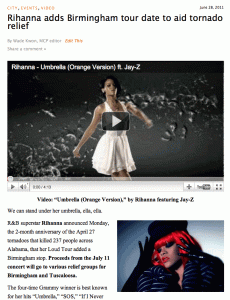 Lots of tags are fine: Use as many or as few are appropriate.
Tags are specific, so let’s use a recent news post of mine as an example: “Rihanna adds Birmingham tour date to aid tornado relief.”
For this post, I used three categories, City, Event and Video. But for the tags …
concert, downtown, fund-raiser, Loud Tour, R&B, Rihanna, storm, tornado, Umbrella
And that’s just nine tags. I usually have more in longer posts.
Both categories and tags help you and the reader find related content, and they help search engines find your post.
Taking just 60 seconds to properly categorize and tag your posts will help tremendously with SEO and help your blog rise above a crowded field.
•
Have a blogging question? I love sharing my answers
and insights (and hearing your suggestions, too!).

Jen West: blogging with passion

Jennifer West and I have been friends for some years now, though we couldn’t be more opposite in demeanor. She is bubbly and laughs out loud, and I’m crabby and quiet.
But I’ve had the privilege of working with her on various projects over that time, including publishing her movie reviews for the local film festival and interviewing her about her trip to New York to appear on “The Rachael Ray Show.”
Her blog, the Jen West Quest, started as a way to document her goal to lose 45 pounds. It turned into major opportunities, including working with Health magazine and appearing on a national talk show. And since its debut on March 30, 2010, this Birmingham blogger has posted something every day.
I interviewed her by email to find out how she did it, why this blog became successful and ways others can reboot their blogging effectively.
•
You have blogged for 449 days straight. What’s your secret?
Discipline! 🙂
Actually, I look forward to writing every day. It’s a great release, and I always surprise myself that I can come up with pretty interesting content most days. If I’m at a loss for words, all I have to do is focus in on what I’m feeling at that exact moment. I actually find that I can say too much instead of not enough.
Since I blog every day, I try to keep my posts between two to four paragraphs as to not burn myself out and to also make it easy to read. Nothing is worse than trying to read something that’s too long and complicated.
Do you consider yourself a blogger? A writer? Why/why not?
I definitely consider myself a blogger, but for some reason, I get all shy when someone refers to me as a writer. It’s never been easy to give myself that title because I feel like it’s a lot to live up to and I’m not sure I deserve it just yet.
But I do hope to confidently refer to myself as a true writer one day soon.
Do you feel like you’ve lost momentum since accomplishing your original quest to lose weight? Why/why not?
Once I started getting close to my goal weight, I went ahead started planning out what I’d blog about next, since I knew I didn’t want to stop. It has been so useful as an accountability tool, so I thought that I could apply it to almost anything else that I wanted to achieve.
Honestly, I was a bit scared that readers would leave once I stopped talking about my weight loss. I did see my visitors drop slightly, but for the most part people stayed around.
My next personal goal is to write a book, but my plans were temporarily halted by dealing with a divorce, which I’ve also written about from my own perspective. Honestly, the Jen West Quest has become an online diary of sorts, a place where I can talk about my goals and also talk about real-life obstacles. I think that’s what makes it relatable.
You had blogged before on a different site. What made it take off this time as opposed to before?
I did originally have a different blog a few years back that I wrote in briefly when I thought my next big project would be writing a script for a feature film. All that changed however when I was presented with the opportunity and momentum to lose weight, and it just felt right to start over with a clean slate.
I felt that changing directions that quickly on my old blog would be confusing to readers, and I didn’t want to appear scattered. Now that I’ve established a personality and writing pattern on my new blog, it’s been easy to change goals and focus all under the same umbrella of the Jen West Quest.
What advice do you have for bloggers looking to start over with their blogs?
Once you find what you want to write about, just jump in. Don’t fuss too much over the way it looks or all of the back-end techie stuff. Focus on the content, and let it drive itself. Everything else will fall into place with time.
While I don’t think it is necessary to blog every day in order to be effective, I do think it is important to have some sort of a schedule in whatever fashion it happens for you. And most importantly, write about something you are passionate about. If you do that, you can’t go wrong!
Photo: Angela Karen
•
Want to learn more without leaving your Inbox?
Sign up for our e-newsletter today!

Being nosy: The many questions I might ask you

Every client evaluation begins the same way. I ask a lot of questions.
Dozens and dozens. All I do is ask questions.
It’s important, because I’m sizing up your needs and your concerns. Without knowing either, I can’t possibly help you with your communication goals.
I’m an OK salesperson, but I’m a better interviewer, based on my decades in journalism. And even better, I listen carefully to what you have to say.
(It’s a two-way street: I love with potential clients ask me questions, too.)
Here is but a short sample of the questions I might throw your way when we sit down for a free consultation …
- What are your business goals?
- Who is your audience? Your typical customer? Your mailing list subscribers?
- Why do you think social media (or blogging or email marketing or a public relations campaign) will benefit your company?
- What tools are you using now? How effective have they been?
- Who currently handles your communication (or marketing or public relations)? What is their level of experience?
- What resources do you have at your fingertips?
- Who signs off on projects?
- What are your concerns about using Twitter (or blogs or videos)?
- How do you talk with your customers? How do they talk with you?
- What is your corporate culture?
- How would you describe your brand? How would your customers describe it?
- What kinds of equipment are you currently using (computers, cameras, smartphones, iPads)?
- What are your biggest concerns about using these tools? About interacting with customers?
- Is your focus on customer service, on sales leads, on branding or something else?
- What is your timeframe? Your budget?
- What’s the biggest challenge you face right now in your job?
As you can see, these questions aren’t even the classic yes ladder ones to have someone respond to a sales pitch. What I’m really trying to figure out is how best to help you, whether via my services or someone else.
I don’t offer one-size-fits-all solutions. Because the next step is to take all the information you share and create a custom approach to help you succeed.
In asking all these questions, I inadvertently answer one of your biggest questions: Am I the right communications consultant for you?
•
Are you looking for help with your communication needs?
Contact me for a free consultation.
Photo: Adrian Wallett (CC)
Video: James Spann on “Communicating Weather Info in a Post-Broadcast World”
It’s no secret: I’m a fan of James Spann.
 The popular meteorologist for Birmingham ABC affiliate WBMA-33/40 is known for his wall-to-wall coverage during severe weather outbreaks, of which we’ve had quite a few lately in town.
Spann was kind enough to speak in 2010 at a Social Media Club Birmingham meeting. Instead of his usual take on weather for his statewide audiences, he spun us a tale of the future of broadcast and social media that impressed the hell outta me and others in attendance.
In this 18-minute video, he presents at May’s TEDxRedMountain on “Communicating Weather Info in a Post-Broadcast World.” Spann shares his insights on breaking news, television, blogging and social media, and how he has used these channels and more before, during and after the April 27 tornadoes.
(Sadly, you can’t see the projected slides and video offscreen, which illustrate his points effectively.)
Also:
- James Spann: weather blog | Facebook | Twitter @spann
- My in-depth report “Twisters, Twitter and You” for Black and White
•
Want to learn more about connecting with big audiences?
Contact me for a free consultation.
 Throughout 2011, I share a daily blog tip via my Twitter account, @WadeOnTweets, at 7 a.m. CDT.
You can …
- Ask follow-up questions in the comments.
- Tweet out your favorites.
- Follow #DailyBlogTip on Twitter.
- And follow me on Twitter at @WadeOnTweets.
•
The tips for May …
- Boundaries can help communities stay active and grow. Untended ones can spin out of control and fizzle.
- How would you market your main product or service? Would that carry over to how you market your blog?
- Revisit old posts for ideas on updates. New posts can pick up the story where it left off.
- WordPress hosted blogs: Set up mobile version in seconds with free WordPress Mobile Edition plugin.
- Video is but another marketing tool for your blog. YouTube and other sites can bring new fans.
- Why I love WordPress: It’s free, open source, flexible, manages content well, always improving.
- A top security measure is regular offsite backups of your blog. Don’t wait till catastrophe strikes.
- Shorter headlines work better than longer ones. Five to seven words, tops.
- Have you asked your community for help? A strong blogger and a strong community deserve each other.
- No amount of marketing will sell an inactive blog. Some time must always go to content creation.
- Shake things up with surprises. Don’t be predictable; be interesting. Keep readers on their toes.
- Tell your site developer to create a mobile theme for your blog, focusing on content useful in the field.
- Spell-check your headlines, too. Don’t make a misspelled word the first thing readers notice.
- When my blog goes haywire, first thing I check is plugins. Turning them back on one at a time can help.
- Make it easy for interested parties to contact you for permission to license or use your content.
- Headlines readers hate: vague, misleading, clunky, erroneous and inept.
- The right community turns an ordinary blog into a shared experience.
- Register for blog directories. Even niche sites can benefit from being listed on free directories.
- My biggest failure with series: Never writing the next part. Have all parts created before publishing.
- Advanced: Allow readers to receive text message updates for new blog posts.
- Edit and improve photos for free at Picnik.com and Photoshop.com.
- Never let your platform be your excuse. Blogs succeed or fail because of you, not the platform.
- Like locks and alarms, no site security system is perfect. It’s a deterrent, but a vital one.
- SEO is always evolving. Today’s rules may not apply tomorrow, so always experiment and document.
- If your fans are bursting with ideas and suggestions, the time is right for adding forums to your site.
- Pick only 2 or 3 social media “share” buttons for your blog. Limit to the ones your audience uses most.
- Exercise buddies keep each other honest, on track, moving forward. Who’s your blog buddy?
- Monitor your traffic from handheld devices: smartphones, iPads and even netbooks. Plan and design.
- Content is the only thing that separates you from 100 million other blogs. The rest is mechanics.
- If a needed plugin doesn’t exist, ask or hire someone to create it.
- Copyright goes both ways: To have your rights respected, don’t steal copyrighted works for your site.
•
•
Want to learn more without leaving your Inbox?
Sign up for our e-newsletter today!
May 2011 media release
FOR IMMEDIATE RELEASE
May 26, 2011
Wade Kwon
mail[at]birminghamblogging.com
BIRMINGHAM BLOGGING ACADEMY TO CONDUCT
CORPORATE BLOGGING WORKSHOP AT INFOMEDIA
BIRMINGHAM, Ala. — As part of Infomedia’s Lunch and Learn series, the Birmingham Blogging Academy will show companies how to manage blogs and websites.
Wade Kwon, head instructor at the academy, will teach Corporate Blogging on June 23.
“This is a great opportunity for local companies to learn how to use blogging and content management to get the most out of their websites,” Kwon says.
The 2-hour session, which includes networking and free lunch, will focus on blogging basics, including setting goals, developing content and promoting it. It takes place from 11:30 a.m. to 1:30 p.m. June 23 at Infomedia, 201 Summit Pkwy., Homewood.
Tickets are $35; seating is limited. Online registration is required.
Website developer and marketing firm Infomedia, formed in 1994, and the Birmingham Blogging Academy, formed in 2009, have partnered before on training opportunities. Kwon is known as Birmingham’s Best Tweeter as chosen by Birmingham Magazine readers and as one of 35 People Influential in Social Media as chosen by the Poynter Institute.
For more information or to purchase tickets, visit http://itswa.de/corp-blog.
Wade Kwon is available for interviews to discuss how businesses can use their websites to bring in more customers. Contact him at mail[at]birminghamblogging.com.
– 30 –
Workshop: Corporate Blogging, June 23 at Infomedia

I do training in companies and behind the scenes. I visit conferences to give talks to specific industries and professionals.
Rare is the opportunity to learn some good ol’ fashioned blogging from me in an easy-access setting.
Guess what?
I’ll be at Infomedia for the company’s Lunch and Learn series in a month. I’ll be talking about Corporate Blogging for a lucky couple of dozen attendees, and yes, lunch is included.
If you want in, it’s just $35 per ticket, which includes networking, great ways to get started in your company blog, interactive learning and, of course, lunch.
The session runs from 11:30 a.m. to 1:30 p.m. Thursday, June 23, at Infomedia, 201 Summit Parkway, Homewood [map].
Hurry! Seating is limited.
Can’t wait to see you in class …
•
Grab your ticket today before they’re all gone.
 Photo: Arik Sokol (CC)
Popular posts: Tell us how you did it
My friend Rachel at Alabama Bloggers had a great idea …
 “I had an idea for a discussion/post on Birmingham Blogging Academy. I’d be glad to participate in it if you chose to do it.
“The basic idea would be to have several bloggers discuss their most popular post(s) — especially ones that draw long-term hits — and analyze the question of ‘What I did right.’
“For instance, I have two posts in particular that are more popular and draw more readers/Google hits/mentions from other blogs than all of my others.
“One is very recent (so therefore it may not have long-lasting effects), and one is over 2 years old. The older one accounts for about 25 percent of all of my blog traffic ever and hundreds of daily readers that started reading my blog because of that post.
“I have ideas and theories on what I did right in these two posts (and they’re very different things for the two posts), but it’d be fascinating to get into an analytical discussion with others about their posts and my posts and share ideas, theories and thoughts on how to do more blog posts ‘right.’ ”
•
Are you game? Send me a note with
your most popular post and what went right.
Photo: Horia Varlan (CC)
Throughout 2011, I share a daily blog tip via my Twitter account, @WadeOnTweets, at 7 a.m. CDT.
You can …
- Ask follow-up questions in the comments.
- Tweet out your favorites.
- Follow #DailyBlogTip on Twitter.
- And follow me on Twitter at @WadeOnTweets.
•
The tips for April …
- Don’t be fooled: Blogging can be hard work. But it can also have deep rewards.
- Does each post have visual appeal? Even 2 extra minutes spent on photos can make your site stand out.
- Plugins add functionality to your site, but they also slow it down. Be judicious in what you add.
- If you care about something enough to blog about it, you will find an audience. Indifference kills.
- I’d rather deal with plagiarists, scrapers and content thieves than having a site not worth stealing.
- Want a crash course in headline writing? Scan through the front page of CNN.com all day long.
- Involve your community: Ask, interact, offer specials, recruit volunteers. Turn one-way into two-way.
- Strong headlines make marketing through social media way easier. Write compelling, clear ones for impact.
- Your blog strategy needs a plan, tied to action steps and deadlines. Map out how your blog will succeed.
- Give mobile visitors a choice: Special mobile version or regular desktop version.
- Good audio for your video posts isn’t difficult. Buy a microphone, test it and use it.
- In changing platforms, research who can help with upgrades, fixes and design over long haul.
- Don’t let hackers into your blog: Use long random alphanumeric passwords, and store them securely.
- Want more comments? Ask questions, take an unexpected stance and pursue hot button topics.
- Your blog can have multiple communities: commenters, Facebook, Twitter, newsletter, forums.
- Marketing your blog begins with knowing what your blog’s focus, audience and goal.
- Create an editorial calendar. Guide your blog through the year with a crafted plan of attack.
- Consider a mobile-only blog, one that caters to those always on the go, or live the computer-free life.
- Edit your posts. Edit your posts. Edit your posts!
- You test-drive cars. Be sure to test-drive platforms before committing to one.
- For WordPress users, upgrading software is an important but easy step in keeping your site secure.
- Even high-traffic blogs receive few comments. Not best metric for determining site quality or audience.
- Any blog can have tons of posts. Community takes dedication, interaction and camaraderie.
- Share your blog posts via social media over and over. Rewrite and refocus. Promote your good content.
- Start comment club with 10 reliable bloggers. Trade comments on member sites regularly. -@johnchow
- Exclusive mobile content: dining tips, grocery lists for recipes, short stories, slideshows, fun videos.
- Photos to use: ones you shot, public domain, bought stock photos, Creative Commons, secured permission.
- Support plugin developers by buying their work or donating directly to them.
- Place your copyright notice with current year in the footer.
- Best comment system allows readers to rate comments and sort them by rating, reply in threads.
•
•
Want to learn more without leaving your Inbox?
Sign up for our e-newsletter today!
The easiest way to start blogging
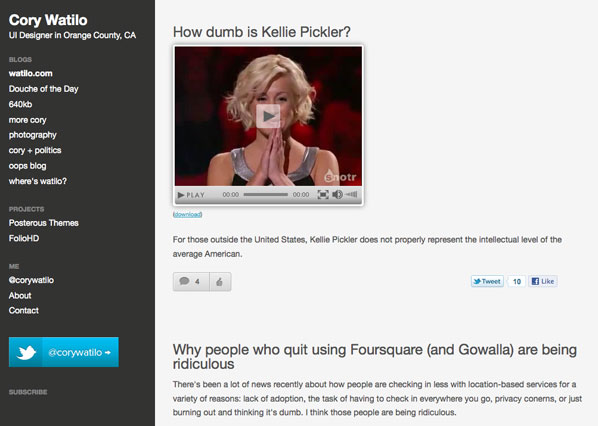
Screenshot of a Posterous site, Watilo.com.
It’s no secret: I’m a big fan of WordPress, both self-hosted and the free WordPress.com. It provides a great content management system and a blogging platform all in one.
But, not everyone needs it or loves it.
One platform I love because it’s so easy to use is Posterous. It’s incredibly easy to start blogging on this platform with one step.
Send an email to post@posterous.com. That’s it.
No registration. No signup. Just you and your email address. (Though if you want to edit posts, or change the styling, or add contributors, you will need to sign in eventually.)
A few tips:
- Your email subject line is your headline.
- An attached photo is automatically embedded; 20 attached photos becomes a slideshow.
- A YouTube link (and other video services) posts as an embedded video.
- An attached Microsoft Word document or PDF become embedded as a viewable, scrollable document.
Amazing, no?
Go try it. Seriously, go try it from your laptop, iPad or phone.
Why would this be a handy option?
- Easy to start one in an emergency. Following the tornadoes, many people needed a simple way to organize relief efforts, and some used blogs and Facebook groups as clearinghouses of information.
- A microsite. If your company or nonprofit organization has a fund-raiser or an event, it’s easy to create a site just around the event, and even a second private one for organizers.
- A test site. Not sure if your company wants or needs a blog? Here’s a no-cost, no-training solution to try it out.
- Preserve your vacation or your party using Posterous.
Sometimes, we overthink blogging. Fortunately, technology has made it extremely easy to start your own site nowadays.
•
Your blog has been set up, but now what. Let’s talk strategy,
content development and more. Contact me today.
What does this story mean to the reader?

Back in my newsroom days, we were scrappy and lean, but we had one tremendous advantage.
A writing coach.
Clarke Stallworth, a reporter from the earliest days of the Birmingham Post-Herald, nudged his way into the newsroom as a columnist and as a coach. Our publisher had the good sense to bring him in to help us with our most basic task, writing.
Alas, not every young reporter and editor took him seriously. What can you teach us, old man? We are Internet and cell phones and 21st-century Journalism.
But a few of us did pay attention.
One of Clarke’s nuggets of wisdom was focusing on the audience. He gave us each a strip of paper to tape to the top of our monitors, so we would see it with every new story we started. Printed on that strip …
What does this story mean to the reader?
If we couldn’t answer that question, we really didn’t have a story on our hands. We might have a nice pile of filler material, but nothing that meant a real impact on the lives of the people in our community.
I teach it in my writing and blogging classes. Are you writing for your audience, or are you just writing for you? One has meaning, the other has mere ego.
One of my newsletter subscribers picked up on that. I wrote about digging to find the meaning of your blog. Does it nurture the soul?
Javacia Harris Bowser read that and thought, “Whoa, that’s a bit too heavy for a Tuesday.”
But then, to her credit, she pondered what she had studied in church and in other emails. And she decided to crystallize her purpose:
“Today, I am committing to being more intentional about what I write here, because one day, when you’re considering what nourishes your soul, I want you to think of GeorgiaMae.com.”
That is fantastic. Now I know I have to read more, because I know this writer is dedicated to considering readers first and giving them substantial material to weigh.
Javacia is going the extra mile, because she already formed a Birmingham-based women writers’ networking group, See Jane Write. I love when professionals reach out to use their skills and knowledge to lift others up.
That is meaningful. That has true purpose.
That is going beyond writing the story for the reader. It is extending your hand to the reader in friendship and in generosity.
With every post, think about Clarke’s basic question: What does this story mean to the reader? If every reporter and writer would answer it honestly, we’d have more great stories to read and fewer head-scratchers.
And when you want to get a bit heavy, consider this: What do you mean to the reader?
Photo: goXunuReviews (CC)
•
Looking for more insights? Subscribe to the free
Birmingham Blogging Academy newsletter!
Blogging, the end game

Every book, every movie, every song has a beginning, a middle and an end.
Every blog … has at least a beginning.
But an end, the end, can be a little murky.
American TV shows can be like that. Dozens of series are launched with many coming to an abrupt, unplanned end, a k a cancellation. Some gain momentum and go on for years, and yet, that threat of cancellation always remains near. Only a lucky, lucky few move on to a planned conclusion. (Unlike the United Kingdom’s BBC, which often commissions shows for limited runs, such as the original version of “The Office.”)
Thousands and millions of blogs are launched, and many come to an abrupt end. You can trace it back in each one, often by seeing an occasional in the waning days, but more frequent posts the further back you dig.
Is that how your blog will end, burning out and then fading away?
How else could it end?
- Book deal, then book.
- Paid blogging or freelancing, including sponsorships, affiliate sales and advertising.
- New career or job.
- Selling the blog.
- Achieving a dream or a long-term goal, such as losing weight, running a marathon or traveling abroad.
How could your company blog end?
- Loyal customers.
- Better service.
- Transparent communication.
- Better brand identity.
- Industry leadership.
- Product development.
Think carefully. Envisioning a successful end, or outcome, for your business blog is the first step in making it happen.
Photo: Corinne Schwarz (CC)
• • •
What’s the next step?
Contact us for a free consultation
(on our redesigned contact page).
Throughout 2011, I share a daily blog tip via my Twitter account, @WadeOnTweets, at 7 a.m. CDT.
You can …
- Ask follow-up questions in the comments.
- Tweet out your favorites.
- Follow #DailyBlogTip on Twitter.
- And follow me on Twitter at @WadeOnTweets.
•
The tips for March …
- Take a step back from your blog to dream big. Imagine the impossible, then start making it possible.
- Want to know how other bloggers do it? Ask them. Bloggers are the most generous people in the world.
- If you want your blog to be more than a hobby, treat it like a business. – @problogger
- Blogging isn’t about writing — it’s about sharing. In words, photos, videos, podcasts and more.
- Would you read your blog on a phone’s small screen? How can you improve the mobile experience?
- Start small with a blog series, two and three parts. Plan ahead, write ahead, connect the parts.
- A strong post has lots of “hooks,” easy ways into the story to share multiple times in social media.
- Know your community. Are they opinionated? Shy? Active? Passive? Do they want info, laughs or empathy?
- Is your headline sexy? Rewrite that sucker until it sings *and* serves SEO.
- Do you really need to learn advanced HTML, CSS and Java, or do you need to invest in a good Web designer?
- For stories, photos should complement text. But your words should do the heavy lifting in evoking imagery.
- For photos and photo essays, the text should give context and depth without repeating what’s in the shot.
- Blogs with product/service reviews should be being mobile friendly. Helps customers check while in store.
- Don’t worry about the other guy’s blog. Focus on your site and what you can do with it.
- Beware the ideas of March. Brainstorm with fellow bloggers about the next great project for your site.
- Ashamed of your blog? How can you fix it so you’re proud of it? The solution begins today with you.
- Who has given your blog the most publicity? Thank them, and return the favor.
- Promote interaction on your blog with open threads, questions, polls, forums and unmoderated comments.
- Dig into your blog comments. A reader has hidden a great topic idea in there for you to find and use.
- Spring means renewal. If you could reboot your blog, what would you focus on, and what would you discard?
- Spring cleaning! Take away everything in your sidebar, header and footer that isn’t click-worthy.
- Make sure your anti-spam software/plugin is up to date. Protect your site.
- Time to switch to new platform? No need to move your blog by yourself: People and new software can help.
- Good writing shows off smarts, but good video shows off personality. Expose yourself on camera.
- Blogging from your phone? Do a few dry runs before going in the field. Expand your blogging capability.
- Blogging from your phone: E-mail a post/photo to special address, or use mobile version of your platform.
- Blog carnival: Collection of various blogs’ posts on one topic, to build community and to increase views.
- Is your blog’s Facebook page thriving? Offer different and valuable things related to your blog there.
- One way to reward commenters: Visit their blogs and leave meaningful comments on their posts.
- Write for your audience, not for SEO or Google. Great writing has great SEO value.
- Did a “thief” steal content deliberately? Address issue with nice e-mail asking for link and excerpt only.
•
• • •
Want to learn more without leaving your Inbox?
Sign up for our e-newsletter today!
The secret lives of trolls and haters

From left, blogging colleagues Rachel C., Rhoda Montgomery and Valerie Gail.
I’ve managed online communities for 15 years, and I thought I had dealt with the worst of humanity.
How very wrong I was.
At a recent Alabama Bloggers lunch, the conversation turned by chance to trolls, spammers and haters. Bloggers often know what trolls are all too well, the persistently nasty commenters itching for a fight. One of my personal pet peeves has been comment spam, an automated nonstop system of adding linked comments to a blog. And as the old proverb goes, haters gonna hate.
My friends and fellow bloggers regaled us with tales of the worst trolls to ever set foot on the Internet. I was floored.
When you have to bring in an attorney, or fight a troll for 2-plus years, that easily trumps any of my online battles.
I asked three Birmingham blogger sto share war stories and insights via e-mail interview:
- Rachel C. of Grasping for Objectivity in My Subjective Life (and also Alabama Bloggers),
- Valerie Gail of It’s a Wonderful Life and
- Rhoda Montgomery of Southern Hospitality.
Between them, they have a dozen years’ experience and thousands of readers for their thousands of posts.
Thanks to all three for their participation.
•
Do you have a published comment policy on your site? Why or why not?
Rhoda: I haven’t actually published a comment policy, but just reserve the right to delete those that I do not wish to promote on the blog. Letting a troll loose is just asking for trouble, as they really enjoy negativity and sparring back and forth. Ignoring them seems to be the best defense.
Rachel: I’ve actually just been thinking about doing this over the past few weeks, but to write it in a humorous way.
Valerie: No, I just never have thought about having one.
•
How do you deal with negative comments, and what do you consider “negative”?
Valerie: I will leave negative comments because not everyone agrees with me. I hardly have ever responded to them. I will delete only if (it includes) profanity or just ugliness that doesn’t have anything to do with the post, or (if it’s) a personal attack on me or my family. Any profanity or just meanness or lies, anything that they may write to try to hurt me or someone else — to me, that is uncalled for.
Rhoda: I consider anything that is hurtful and bashing (as) negative. I don’t really mind if people disagree with me or a project that I’ve done, as long as they do it nicely. If they just want to say mean things to get their point across, I delete. It’s my blog, and I choose to keep it a positive place. Negativity has no place in comments, especially mean and hurtful ones.
Rachel: I will leave any comment from a regular reader. I will also leave negative comments from new people, if they are logical and polite.
I will not leave comments from people who are searching the Internet looking for a fight to start, because I really hate fighting.
I started out trying to reason with (a persistent troll). That didn’t work; it just made her worse. Some bloggers enjoy the back and forth commenting with an obviously crazy person, but I didn’t. So then I started to just delete her comments immediately, which seemed to be the most effective. It took all of the wind out of her sails to know that no one saw her comments. After I started doing that, her comments became fewer and farther between. [See more below.]
I felt guilty about this at first, because I had always believed in letting all comments show, because it was honest feedback. However, since then, I have changed my philosophy.
•
How do you deal with comment spam on your blog?
Rachel: I use Akismet (a WordPress plugin) to filter spam. It works very well.
Valerie: I usually don’t. (Blogger) has a comment spam folder now, and I have yet to have one get past that.
Rhoda: I’m on WordPress, so spam goes directly into my spam folder, and I can go in and delete. It helps a lot to have a plugin (like Akismet) to deal with spam, and 99 percent of it is captured this way.
•
Who’s the worst troll you’ve ever had to deal with? Did you know that person personally? What did you do?
Rhoda: I have had one (I think they were originally three different people and only one still comes by) who has harassed me for almost 2 years. She comes by to leave ugly comments, telling me all the things that she doesn’t like about me and my blog. She criticizes what I do on my blog, tries to interject in my personal life when she knows nothing about what is really going on with me and just generally makes stupid comments about things. She really likes to get involved in my personal life a lot.
The only thing I can do is block the IP address so that the comments go into spam. They don’t come back all the time, but will wait awhile and then show up again. I just deal with it!
Valerie: It was two sisters who went to school with my daughter, so I knew them personally. I got together all of their negative comments, which included just outright lies about me, my daughter and grandchild. They were also trolling me on Twitter.
I then got in touch with a friend who is a lawyer, and (the trolls) got word that an attorney was involved. They have each had two different Twitter names, but deleted their accounts after I got an attorney involved.
Recently, however, they have both created another account and have started to follow some of the same people I follow again. So I am hoping they don’t start trolling me again.
Rachel: My troll originally came from this 2008 post when my husband and I happened upon a strange event in Atlanta, and I wrote about it from an outsider’s perspective. I meant the post all in fun, really in awe of just happening upon such an odd event, but she took it as me making fun of her and her friends. She left some nasty comments, but mostly kept her attacking of me on the event message boards, linking to my blog and talking about what an awful person I was. Luckily for me, almost every other event attendee thought my post from what they called a “mundane” was hilarious, or ignorant at the worst.
She bugged me on and off that year, but she really got nasty after my recap of the 2009 event. On that post, she left multiple comments under different names (but all from the same URL), trying to make it look like “everyone” was offended by my post (which they weren’t).
I made the mistake of trying to reason with her on that post, but it just fueled her fire and made her more maniacal in her comments. She also began reading all of my post archives and every new post, of course skewing the intent of them and leaving nasty comments every time she could twist something to be offensive.
The worst comment she left was at the beginning of 2010, where she spent at least 2 hours writing a comment longer than the post itself, citing at least 15 different blog posts over 2 years, “proving” that I was the worst human being on the planet. She said many very hateful and horrible things about me that, although I knew they weren’t true, they were still hurtful.
She has continued to leave random nasty comments since then, and, according to my stats, regularly reads my blog.
Although I left most of her original comments on the original two posts, I have since deleted all of her comments.
•
Bloggers: Share your horror stories with trolls, spammers and haters in the comments below.
Throughout 2011, I share a daily blog tip via my Twitter account, @WadeOnTweets, at 6 a.m. CST.
You can …
- Ask follow-up questions in the comments.
- Tweet out your favorites.
- Follow #DailyBlogTip on Twitter.
- And follow me on Twitter at @WadeOnTweets.
•
The tips for February …
- Include the entire post in the RSS feed. Make it easy for readers to see your content.
- Comments are love. Respond to your commenters in a timely and meaningful fashion.
- “What keeps your customers up at night? THAT’S what your blog needs to be about!” -@juntajoe
- Think of your blog as a work in progress. You should always have things to fix, ideas to implement.
- Tell me a story with your post. Draw me in with surprise and misdirection. Leave me wanting more.
- Super Bowl teams and successful blogs both practice, adjust, fail big and win bigger.
- Rename your photos from generic filenames to descriptive keywords for better SEO.
- Back up your blog regularly. Better: Find a way to automate it, but check on backups every month.
- Domain names make for inexpensive branding. Grab a few, try them out.
- If you copyright your blog, stand up for it. Copyright protection begins and ends with vigilance.
- Why link to a PDF when you can show it off with Box.net, SlideShare or another embedded viewer?
- If you don’t know your blog’s focus, blog more. The focus will come.
- Take time to edit your posts before hitting send. Reading it aloud helps tremendously.
- Send a Valentine to your readers by telling them how much you love them.
- Make sure your podcasts are feed into iTunes for another free channel of distribution.
- Consider Creative Commons licensing to spread your work while maintaining your ownership rights.
- Write the headline first. It can guide you in writing a tight, focused post.
- Reach out to other bloggers you read with a kind e-mail. Build your network.
- Check your blog for branding consistency. That includes social media, e-mails, RSS feed and promos.
- It’s not, “How can I get more blog readers?” It’s “How can I be more interesting on my blog?”
- Who would you like to write a guest post for your site? What’s in it for them? Time to ask them.
- Optimize your site’s look for phones, so they can see it quickly and easily.
- Include your site URL in every video, so viewers know where to go next.
- Plugin/widget checkup: Take out every plugin not needed. Slim down your site.
- Tag every post. Great for SEO, and helps with finding related content on your site.
- I love the blogs that show off their commenters’ most recent blog post. Good karma.
- Get business cards made for your blog. And hand them out.
- Some get fired up by blogging all the time, others get burnt out. Which are you?
•
• • •
Want to learn more without leaving your Inbox?
Sign up for our e-newsletter today!

Stacey Hood, left, and Kristen Heptinstall discuss the new Alabama
Social Media Association with Rick Journey on Fox 6’s “Good Day Alabama.”
We knew we had a good thing on our hands. But you never really know till you put it out there.
And so, when we launched the Alabama Social Media Association on Tuesday, we hoped for good response.
Instead, we had an avalanche of good will. It was unbelievable.
So many things went right. I want to share how we as a team pulled it off, so your next launch — new business, new product, new campaign — can be as successful.
• Build something fantastic. It’s much easier to whip up excitement when you have something awesome to share. We spent months putting together this organization.
We started with the right people: We shared common goals in building a group that would serve the community, not ourselves. And we weren’t ashamed to get outside help. Flying up Whitney Breaux of the Baton Rouge Social Media Association to advise us was the best money we ever spent. The guidance she gave us, including mistakes to avoid, helped us move very quickly from brainstorming to planning to launch day.
If you’re going to start a group, hire her.
And if other cities in Alabama want to start up their own chapters, we are here for them. The game plan can be copied, modified and done again and again. But it takes dedicated people working toward that common goal to create something extraordinary.
• Communicate. Sounds easy, right? But when even one team member fails to notify the others of a possible problem, it can turn into a real nightmare real quick. (More on that in a future installment.)
We erred on the side of communicating everything. Note that we didn’t err on the side of meeting too frequently. That makes for a huge difference.
We collaborate through a combination of Google Docs, a private Facebook group, e-mail and phone. We have each others’ backs. Of all of those, the Facebook group has been a huge life saver and time saver.
(Two years ago, I would have set up a small mailing list to collaborate via e-mail. And judging by the threaded comments in our Facebook group, we would easily have hit 1,000 e-mails with a couple of weeks.)
Even incremental progress is typically noted in the Facebook group: meetings, phone calls, completed tasks, stalled tasks, updates all make for daily fodder. It can be a lot to navigate on busy days, but for the most part, it has kept everyone on the same page. So very critical with tight deadlines, autonomous board members and a thousand moving pieces.
• Assign a taskmaster. As a five-member board plus one executive director, we are all equal. We know each other’s strengths and shortcomings. But we are all free to handle our business as we see fit.
That can sometimes lead to stalemate, to apathy, to confusion. What helps is to have a taskmaster.
From the start, we knew unquestioningly that the role would fall to Jeff Vreeland, chairman of our board.
Why Jeff? He came in hyper-organized. He took charge immediately. And no one wanted to kill him for it.
Just the opposite: We wanted to support him in that thankless role.
Jeff doesn’t let idle chatter spin into a longer meeting. He keeps the group focused on task and on topic. He takes copious notes and assigns action items. He drew upon his years of experience in management and leadership, among businesses and nonprofits to step up.
You don’t want to let Jeff down. Because he will push to ensure that we keep moving forward.
When you have a seemingly impossible list of people to contact, sponsors to secure and questions to answer, it helps tremendously to have someone prioritizing and delegating. Jeff has done that admirably without losing patience or accepting an adequate solution when a great one is out there waiting to be discovered.
He hasn’t engendered resentment. He’s earned respect.
•
Luck played a part, as did flexible planning. So did persistence and prayer.
A couple of things fell short on our launch, but so many things went right, we can’t complain. Our event sold out quickly. We received great questions and no negative feedback. We worked the plan almost flawlessly, including social media outreach, traditional media positioning, buzz building and delivering on our promises. And people are excited.
As I have applauded our success, I have cautioned against cockiness and complacency. We still have an event to run. We still have a membership to grow. We still have many, many people to bring into the fold. But the Alabama Social Media Association is off to a fantastic start.
It took a lot of people, a lot of work, just enough time and a great community at the heart of it all.
Completely and totally worth it.
•
Also:
- Fellow board member Erin Street reveals more from the ALsocme launch.
- Alabama Social Media Association website | free newsletter signup
• • •
Need help with project management and communication?
Contact us for a free consultation.
Announcing the Alabama Social Media Association
I never sit still.
 Too much to be done. Too many people to meet. Too much good stuff to share.
For the past 6 months, I’ve been working on a top secret project with friends to create something worthy of a city on the move that is Birmingham.
Today, I’m happy to announce the Alabama Social Media Association, a new nonprofit organization dedicated to educating anyone and everyone in social media. We will offer lunch meetings and social events — at least 12 in 2011 — to bring people together in Birmingham around this passion we share.
And it’s all free. You won’t have to spend a single penny to learn more about the ways you can use social media with your business, your nonprofit group or for yourself.
All you have to do is tell us you’re going to show up, and then … show up.
As a founding board member, I have been meeting with people throughout the community to bring this group to life. I am genuinely thrilled and touched at the support coming from established organizations and their representatives for this completely unknown venture.
We reached out because we wanted to establish ties right from the beginning. We don’t operate as an isolated entity — we are all about connections.
I did not do it alone. I have been working with some great people along the way, starting with the other founding board members Stacey Hood, Erin Shaw Street and Jeff Vreeland, along with our founding executive director, Kristen Heptinstall. What a delight it has been working with them in every spare moment we could scrape together. They care deeply about social media, Birmingham and Alabama, but more important, they care about people. And each one of them has been unselfish in their time, their deep knowledge of these new channels and their passion.
I also want to thank Whitney Breaux, executive director and co-founder of the Baton Rouge Social Media Association. Her advice and support helped us in countless ways. We love Whitney and the rest of the BRSOCME group.
I will not attempt to list every single person who has lent a hand in this journey, but I do want to single out four more people to thank: Phyllis Neill, Trish Bogdanchik, Tim Clay and Eric McClain.
Join us at ALSOCME. Meet us. Teach us. Move forward with us.
•
Our inaugural meeting will be 11:30 a.m. to 1 p.m. on March 30 at the Hill Event Center, with lunch provided by Zoës Kitchen. The speaker will be Ike Pigott on “Social Media: the 21st-Century Canary,” using social media for crisis management and prevention.
Seating is limited, so RSVP for this free event at ALSOCME.com.
Update: We sold out in under 3 hours. But please visit the site to sign up for both the waiting list and our regular mailing list for updates on upcoming events.
BlogWorld goes bicoastal, but should you attend?

BlogWorld attendees talk and relax in the “lounge” area.
BlogWorld and New Media Expo, the biggest social media conference in the world, dropped two bombshells in the last week.
First, the conference has always been in Las Vegas in the fall. But this year’s show will be in Los Angeles on Nov. 3-5. For those of us in the Southeast, that will not make much of a difference.
Second, the conference added a second show in May on the East Coast. BlogWorld will be May 24-26 in New York. For those of us in the Southeast, this makes a huge difference … or does it?
For many of you, the two biggest factors are cost and time. I can’t help much with cost, since it will vary widely by individual: home airport, ticket prices yet to be announced and so on. Let’s say it’s going to cost you at least $1,500 to go as an attendee. Will you get $1,500 worth of value out of it?
You’ll also be spending up to a week away from your office. So add in that cost, too.
The other question that frequently comes up is: What’s in it for me?
I can help there. I’ve been 3 years, 2 of them as a speaker. I don’t favor the “eggs-in-one-basket” approach, but for many of you, this is an opportunity you should have done in 2010 or earlier.
Five reasons to attend BlogWorld in 2011
1. Networking with the right people, especially those closer to home. Being at BlogWorld and making meaningful connections has paid off for me. It has led to more paid speaking gigs, business opportunities and more. And it’s not a one-way street: I have referred business to new contacts as well.
I expect to meet more people from the South in New York than in Vegas or L.A. (fingers crossed). Attendance from this region at BlogWorld has been pretty low, and that’s to be expected. While I’m open to working with anyone anywhere, having a regional tie-in has helped on certain occasions.
2. Learn from the best. I adore the regional conferences I attend, both in terms of learning and networking. But no conference can compare to the depth and breadth of the BlogWorld lineup. (And I write this without knowing who will end up on the New York lineup in less than 3 months.)
The biggest conference gets the best speakers. Period.
3. The conference has grown up. After 4 years, it has ably managed to grow and prosper. Its reputation is solid, and it pulls together thousands of bloggers under one roof. I will miss having it at Mandalay Bay — a near-perfect venue — but the conference has already outgrown it and Vegas, too.
So you can expect a good return on investment from an established brand. It’s expected to add $3 million to the L.A. economy. (Pretty good for a blogging event that still doesn’t have an entry in Wikipedia …)
4. For traditional media, it’s a lifeline. Coming from the world of publishing, I know all too well the challenges for mainstream media. BlogWorld is committed to being a bridge between old and new media, with a deliberate focus on content. That aligns perfectly with my experience and my methods.
Tools come and go. But content that engages can last forever.
(BlogWorld East should prove to be especially interesting, as it has scheduled itself to coincide with Book Expo America.)
5. You have something valuable to share. I cannot stress how important it is for you to share your knowledge in blogging as a conference speaker. Having BlogWorld on your resume is a significant achievement.
If you’ve spoken at several conferences and plan to send a proposal for BlogWorld East, you’d better hurry. Deb Ng, the conference director, has put together a new guide for proposals in this accelerated period.
Five reasons to skip BlogWorld in 2011
1. You’re not ready. And that is not meant to be an insult. A big conference requires prep work and some experience to maximize the ROI.
I will often skip seminars at conferences, simply because I know the material. My time there is better spent networking or just plain working. At BlogWorld, I study the schedule to ensure I’m going to the sessions that will benefit me most in the long run. (And I’m still working out some projects that sprang directly from some great talks in 2010.)
If BlogWorld is in fact your first blogging or social media conference, you may be overwhelmed with info and with contacts. Talk about a lost opportunity should you return paralyzed with what to do next.
2. Your blog is your hobby, not your business. If you don’t plan to make money or use your blog to grow your business, skip BlogWorld. Otherwise, your hobby will become very expensive.
3. The waiting period between conferences has decreased. Skipping BlogWorld this year means only having to wait till May 2012. That gives you plenty of time to set aside time and funding for the big trip.
Plus, you have a small waiting advantage: Seeing how things shake out in the inaugural New York and Los Angeles events means a better experience in 2012. You may miss out on the conference, but you’ll also miss out on inevitable glitches in facilities, transportation, logistics and more.
4. Your time and money are better spent on resources closer to home. Can you name five blogging and social media conferences within a 3-hour drive of your home? If not, start your Googling.
Birmingham is blessed with blogging, social media and other cutting edge conferences. Plus, we are within easy reach of WordCamps, SocialFresh and others within a short radius.
Get to know where your backyard conferences are. That’s where you begin real networking and sharing.
5. Your business needs you. You’re indispensable (or at least, I hope you are). That means you could spending that conference time on sales, marketing, research, networking, training, accounting and the other million tasks you need to be doing in your job.
Those activities could produce more immediate results than the less tangible benefits of networking and learning at BlogWorld. No matter how efficient you are, you might not be able to get away for 3 or 4 days.
It’s always a challenge for me, because that means extra work before, during and after the conference.
•
I hadn’t planned on going to BlogWorld this year, but New York makes it somewhat easier to manage.
I’m still weighing whether to apply to be a speaker at BlogWorld East. I owe Deb an e-mail, though she’s already been inundated with questions.
Consider carefully your investment and your possible rewards for going to BlogWorld. I’d love to see more attendees and speakers from Birmingham and around the South, so feel free to ask me questions I haven’t covered.
After all, you want to see the biggest conference in action someday, right?
•
Sponsor opportunities: If your company is interested in sponsoring my trip to BlogWorld, let’s talk. Contact me by e-mail at mail[at]birminghamblogging.com for details.
Photo: Shashi Bellamkonda (CC)
How to conquer Ignite: the four Ps of polish
Video: “Birmingham, Food Capital of the World,”
an Ignite Birmingham talk by Wade Kwon
Too many people equate an Ignite 5-minute talk with “wing it.”
In some ways, a shorter presentation requires more care and preparation than a 30- or 60-minute talk. Good public speaking requires practice. Outstanding oration requires almost nonstop practice.
Having done sessions for 30 seconds and for 6 hours, I want to share some advice for Ignite presenters. You have 5 minutes, 20 slides and not a moment to waste.
For those not familiar, Ignite talks have a diverse lineup of speakers and topics. The gimmick is that each presenter can have up to 20 slides, which auto-advance after 15 seconds each. The goal is to share an idea or a passion with the audience. (But no sales pitches.)
In Birmingham, we had our fourth Ignite last week, and I was honored to be the kickoff person for the evening with “Birmingham: Food Capital of the World.” We do a great job rounding up people ready to stand before their peers to teach us. We could do a better job of preparing them for that task.
Slides from “Birmingham: Food Capital of the World”
Let’s learn about the four Ps of polish: proposal, PowerPoint, practice and presentation.
 The proposal: I have no formula for what makes a perfect topic. A dry topic can light up the room with passion and wit. A fantastic topic can be rendered mind-numbingly dull with poor stage presence.
When submitting a topic proposal, think narrow. You have 5 minutes to get your point across, leaving little room to wander. At best, you’ll be able to back up your premise with two or three supporting points. Add an intro and a conclusion — “I’ve run out of time” is not a proper conclusion — and those 5 minutes can be constrictive.
Consider your talking points as you write your proposal title and summary. And make your title as sexy as possible. “Birmingham: Food Capital of Jefferson County” doesn’t quite have the same ring as “Food Capital of the World.”
An important question to consider is: What does the audience get from this? Understanding? Insight? Laughs? Be sure you have a good answer.
The PowerPoint: Simpler is always better. Fancy transitions and video clips are just begging the computer gods to derail your slides.
So what do I mean by “simpler”?
For starters, each slide should have as few words as possible. We’re not here to read your novella, Melville. You can create a deck with just images, no words. After all, you’re talking for 5 minutes … that’s a lot of words.
The words are signposts for you: They help you keep track of what’s coming up next in the speech. Any more than five or six words per slide will be lost on the audience.
Professional photos that fill the screen make for a dynamic presentation. It’s something I first saw in Mack Collier‘s talk at Social South in 2009 and have used more and more in different presentations.
Nonstandard fonts and unusual transitions may not work on the host computer. Even knowing all the quirks, I still had three slides with problems during my Ignite talk last week (more on that below).
Do yourself and your audience a favor: Keep it simple stupid.
The practice: One Ignite presenter started with the fateful opening, “I haven’t looked at these slides since I turned them in.”
I almost walked out.
Even the most polished keynote speakers practice all the time, including before they give the same speech for the hundredth time. This is why they command $5,000 and up per talk.
A 5-minute talk is short enough to practice on the commute to and from work, in the shower and while making popcorn in the microwave. Ideally, your first few run-throughs are in front of one or more people. This lets you know where to pause for laughter or for baffled looks. Your slides may already be turned in at this point, but you can still fine-tune your words and pacing.
Set your computer to loop the presentation. In 30 minutes, you’ll have practiced six times. In an hour, 12 times. Do not underestimate how much better you get each time you run through it.
•
When the slides are a surprise …
How to conquer Ignite Karaoke
•
Another Ignite presenter confessed that her nerves got to her, and that she blanked out when she hit the stage. But because she had practiced over and over and over and over, she went on auto-pilot and delivered a fine talk. (Not that I recommend you let your nervousness get the best of you.)
Practice while standing up, and use a video camera if you need to review yourself. You’d be surprised how easy it is to correct little distractions once you spot them. Try using a hairbrush as a microphone; get used to having one hand out of commission as you make gestures while you talk. (And if you’re holding notes in the other hand, you may not be gesturing much at all.)
Are you pacing? Plant your feet. I suggest only moving a couple of times during your 5 minutes and planting them for most of the time. Put your nervous energy into your passion for your topic through your vocals and your gestures.
Ideally, you practice to the point where you don’t need notes. Your slides are your notes. Having a written-out speech in your hand tempts you to read to us, but don’t do it. If you need to have notes on hand as a crutch, just use keywords to trigger the next idea.
The presentation: It is easy to let nerves drown out all preparation as you approach the stage. This is where practice pays off, trust me.
When you’re about to start, take a deep breath. Slow down. Your intro should come rolling out of you, as though you rehearsed it and it alone a hundred times. “Um, OK” is also not an acceptable way to start a speech.
Glance at your slides, but look at your audience. They do want to hear what you have to say. Showing that you’re handling it like a professional, that you value their time, goes a long way in winning over an audience.
Don’t read your notes, and don’t read your slides aloud. Talk to us. Share the enthusiasm you would have if you were talking to your best friend. And don’t hide behind the podium. The temptation will be to rest your hands on top, rather than use them naturally to gesture.
Pacing is extremely critical in an Ignite presentation. That 15 seconds per slide may seem like an eternity, or a blip. But it’s just 15 seconds, over and over. For someone like me who is used to changing slides manually, this is a difficult adjustment. I will never have a perfect 15 seconds of material per slide.
But I compensate in two ways. If I’m talking and the slide changes, I don’t abruptly halt. I finish my point as though I meant it to happen. And then I start talking about that slide. If I’m talking and run out of material while the slide seems to hang there forever, I begin the transition to the next slide. I know what’s coming next, so I start talking to lead people into that slide as though I meant it to happen.
I don’t speed up. I don’t slow down. But I do continue my speech as though the slides aren’t there.
Things will go wrong. Most commonly, the slides won’t display as they should. I had three slides with missing or hidden text. All I did to adjust was to recite the text no one could see. I doubt anyone noticed.
You might forget a point. It’s OK to pause and gather your thoughts.
You may think you’re panicking, and that everyone can tell. But mostly, it’s in your head. Keep going, have fun, don’t stop.
And end with a strong closing. Make it memorable, and bring home what you’ve been talking about for the last 4-plus minutes. Rehearsals ensure that last slide won’t sneak up on you, as it has for many unprepared speakers.
•
Ignite can be great fun, for the audience and for the speakers alike. The thing most first-time speakers discover is that it isn’t nearly as difficult as they had imagined.
Being a polished Ignite speaker isn’t as difficult as you might think. Submit a great proposal, design a succinct but visually appealing PowerPoint deck, practice thoroughly and deliver a smashing presentation. The four Ps.
And don’t forget the fifth … have phun!
Photo: Josh Self
• • •
Need help with your next speaking engagement?
Contact us for a free consultation.
I want to write a guest post for your company blog
This week, I’ve been sending the follow message through my social media channels …
Looking to do a guest post on Birmingham-area company blogs. Message me if you’re interested.
A few details to fill in the blanks.
What topic would you write about?
It’s your call. I’m flexible on topics.
How much are you charging?
It’s absolutely free.
Where have you written guest posts?
- BlogWorld,
- Alabama Bloggers,
- Okra Cola,
- Jamie’s Rabbits,
- Ignite Birmingham
- and so on.
What’s your angle, Mister?
I don’t think I like your tone, Imaginary Interrogator. I want to reach out to companies in Birmingham to get to know their people, their passions and their online presence. Nothing more intimate than thinking about how to write within a brand.
What if you do a horrible job?
Ask me to rewrite it, or consign it to the Recycle Bin of history.
Do I have to write something for your blog?
Not at all. This is a no-strings freebie. No. Strings.
What do you get out of it?
I enjoy writing for other blogs. Gives me a chance to stretch beyond my regular topics. And helps me think about your business and your customers’ needs. Really, it’s fun!
How do I sign up?
It’s easy. Just send me a note, and we’ll go from there.
Photo: Stephen Pierzchala (CC)
• • •
Need help with your company blog?
Contact us for a free consultation.


 Birmingham Blogging Academy