The digital revolutions
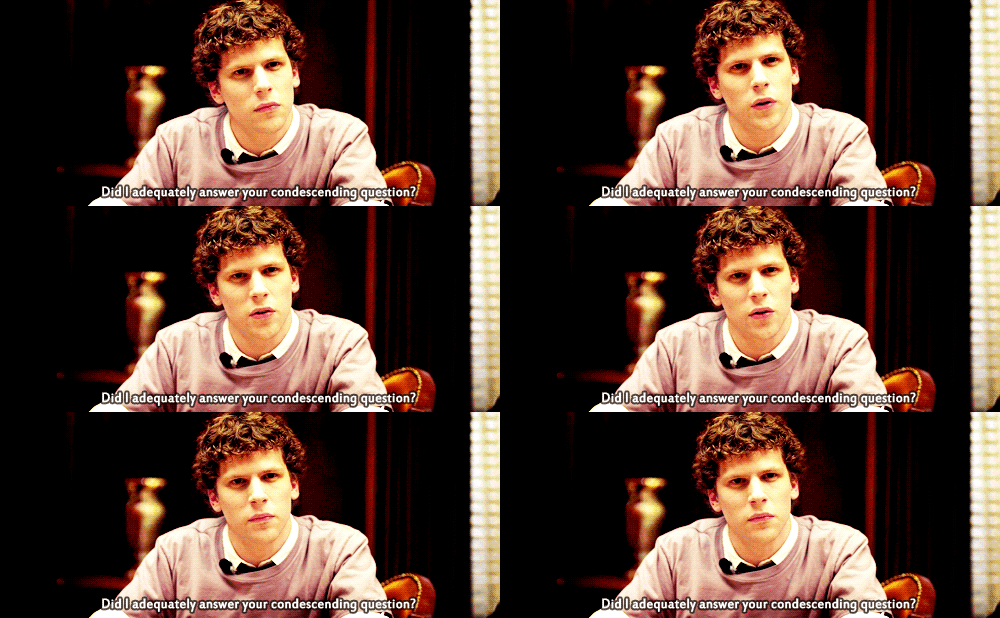
Jesse Eisenberg as Facebook co-founder Mark Zuckerberg
in “The Social Network”
In my DVD binge of late, I watched two movies that have been on my list for some time: “The Social Network” and “Moneyball.” (I plan to read the books behind both flicks, too.)
We live in historic times, witnesses to two kinds of revolutions that affect how we work and live. These movies show the origins of these world-changing concepts, and coincidentally, feature Aaron Sorkin as screenwriter.
“The Social Network” gives the background on the founding of Facebook and Mark Zuckerberg’s rise to world’s youngest billionaire. We see how the gifted Harvard student figured out the psychology behind social connections (online and offline) through flashbacks from two deposition hearings.
Facebook isn’t the star of the movie but more like the virtual love interest among many jealous and bitter rivals. We don’t examine too closely how it affects the world, just the players fighting for control.
Perhaps a movie with three Oscars doesn’t need to dive too deep into the Facebook’s impact on our daily lives. After all, you may be reading this right now because of a link from Facebook. Or you may feel compelled to discuss the movie and its ideas … on Facebook.
It changed how we connect with people, how we market to people and how we measure our lives. All it may take is a virtual snub — no party invite, no change in relationship status — to turn a dear friend into a fearsome enemy. At the very least, it has brought high school social politics from the dark recesses of our egos onto the Internet for all to witness.
Some of you stake success on your Facebook reach, whether raising money for a cause or selling widgets at your company. Some of you get most, if not all, of your news from your connections. You may use Facebook to score dates, kill time and vent to any who will listen.
It was neither the first nor the last social network, but Zuckerberg figured out early on that exclusivity would help his new site become cool quickly. He wanted to replicate the college experience of trying to hook up with others (socially and sexually) through Facebook profiles.
He tapped directly into FOMO, fear of missing out, so that everyone from 15-year-old wallflowers to 55-year-old grandparents would check in several times a day.
I use it, and I teach people how to use Facebook effectively, whether on a budget of $0 or $100,000.

Brad Pitt as Oakland A’s manager Billy Beane in “Moneyball”
“Moneyball” shows another contemporary digital revolution, this one within the hallowed institution of baseball. For decades, scouts had recruited ballplayers based on a combination of skills and “intangibles.” Those scouts knew in their gut who could sell tickets, shore up a team and bring pizazz.
BIlly Beane decides to buck the system. As general manager of the Oakland A’s, he sees his team make the playoffs but fall to the wealthier Yankess in 2001. He hires Paul DePodesta (called Peter Brand in the film) to do the seemingly impossible: Assemble a World Series team on a seemingly Little League budget.
The method to their madness is simple: DePodesta knows numbers, the statistics behind everyone in Major League Baseball. Using an economist’s perspective, he assigns a value to each player based on his on-base percentage and tells Beane to grab the best “bargains,” those players undervalued because they’re seen or ignored based on other less relevant qualities.
It works. And in the process, it upends the conventional wisdom of baseball and temporarily gives the economic underdog the advantage.
Data-driven processes and results have become more prevalent with computers and the people who understand how to capture and analyze the numbers. We see it skillful search engine optimization, and in the reliable election predictions of Nate Silver. And yet, people continue to be surprised when their gut steers them wrong.
“Moneyball” represents the rise of sabermetrics, quantifying a player’s past performance and attempting to predict future performance by relying on relevant statistics, such as runs produced.
Every MLB team uses sabermetrics, and pro teams in every sport have since added their own form of statistical analysis for player evaluation.
We’ve seen advertising over the years as a mysterious voodoo ritual, that something in the casting process works, though we may not know which spell or how effectively. I show people how to quantify past performance of their marketing and public relations efforts and single out the ones to continue (or try) for maximum return on investment.
Both “The Social Network” and “Moneyball” capture the genesis of digital revolutions surrounding our lives. Go beyond watching and take part in these innovative systems to change your own world.
• • •
Let’s work together on your digital revolution.


Blogging for the blogger who doesn’t want to blog

Either you’re committed to blogging or you aren’t.
I like to think of multiple options to problems, but when it comes to blogging, I find most either do it, or give up early on.
However, not everyone has to blog the same way.
Allow me to suggest a few alternatives for those who find themselves stuck when trying to write posts on a regular basis …
- A photo a day to Instagram.
- Autopost from Instagram to your blog.
- Vine videos (in 6-second bursts).
- Weekly curation of favorite links around a topic.
- Video of the day.
- Pin to Pinterest daily.
- Most interesting SlideShare presentation of the day.
- Favorite tweets of the day (you can cheat and use Favstar).
- Favorite Facebook post of the day (you can now embed Facebook posts).
- Lists.
- Interview people by email and post as a Q&A.
- Photo essay.
- Photo with a long description.
- Amazon book of the day (with affiliate link).
- Amazon product of the day (with affiliate link).
- Themed playlist from Spotify, Soundcloud, Last.fm, iTunes or another music service.
- A how-to with step-by-step guide.
- A poem (I prefer haiku).
- Progress reports (room renovation, product launch, pregnancy).
- Charts and graphs.
- Infographics.
- Site of the day.
- Twitterer of the day.
- Pinner of the day.
- Etsy shop of the day.
- Instagrammer of the day.
- Ebook of the day.
- Blogger of the day.
- Hashtag transcripts.
- Product review.
- Movie review.
- Game review.
- App review.
- CD review.
- TV show review.
- Book review.
- Blog review.
- Restaurant review.
- Product unboxing video or photos.
- Maps.
- RSS snippets.
- Sneak peeks (product development, first drafts, models, sketches).
- Polls.
- Giveaways.
- Latest books read.
- Latest movies watched.
- Latest cities visited.
- Latest restaurants visited.
- Best (and worst) reviews of your products or services.
- Screencasts.
- Testimonials.
- Events and other calendar listings.
- Job listings.
- Memes and ecards.
- Anything that doesn’t include the phrase “I was wondering about what to blog today …”
Photo: Faith Goble (CC)
• • •
I can help the reluctant bloggers on your team
get going (and keep going) on your blog.
Notes from a new conference organizer
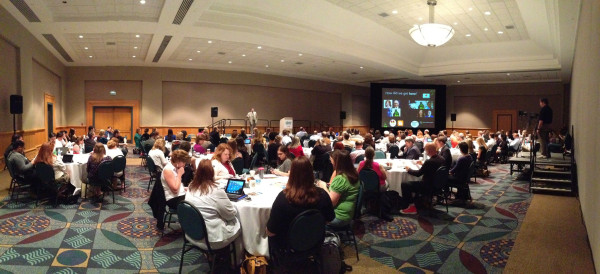
The kickoff of the first Y’all Connect conference in Birmingham
I haven’t had much time to reflect on my first Y’all Connect conference, which debuted last week. Post-conference work, while at a more relaxed pace, still takes up many hours.
But having attended, volunteered at and spoken at many conferences over the years, I’ll throw in my initial impressions as a fully initiated organizer.
• You can’t please everyone, but you can at least try a little harder. Our guests seemed to be pleased with the various aspects of the conference, from the lineup to the food to the wi-fi. But one guest wanted a little something extra.
A book.
I had offered 100 free copies of Mack Collier’s “Think Like a Rock Star” to the first 100 ticket buyers online. They went fast.
This particular guest was not in that first 100, but when she saw everyone else with a copy, she had to have one that morning. (And no, she wasn’t interested in purchasing one from the book table.)
I offered to give her a copy at day’s end if someone didn’t pick up their copy. She was still unhappy.
At lunchtime, I checked on the remaining copies and gave her one personally, with a free drink coupon to boot. She seemed satisfied.
But I had broken my own rule. I had told the volunteers that if they could make a guest happy for under $25, do it. Just spend the money, get a receipt, and give it to me later for reimbursement.
I could’ve just given her the book on the spot and wowed her with responsive customer service. But I let myself get distracted by worries over having enough copies to last the day. Oops.
It’s something I will keep in mind as I work towards delivering better customer service personally.
• Speakers do whatever they want. And I mean that in a good way.
I like to think of myself as a good speaker, and someone who’ll be invited back again and again. The reality is that I’m a pain in the ass sometimes because I want it to go smoothly. (See the legend of Van Halen’s “demand” for no brown M&Ms.) For example, I’ve shown up to gigs where a promised screen and projector were nowhere to be found.
I think it’s fitting that I have speakers who do whatever, whenever, despite the pleas of a harried conference organizer. In a perfect world, I have all contracts and slide decks in hand months before the big day, and that all my very important emails are read thoroughly (twice!) so they’d have no surprises.
Alas, no.
They will still ask about small details already covered, but then again, they travel a lot and the dates start to blur together. Many operate on their own, so no personal assistant is on hand to keep info organized. Some will go over time limits, or balk at a stationary microphone (or wearing a microphone, or standing behind a podium).
I conveniently forgot that I did all of those things in my speaking career. What a joy it must’ve been for organizers and volunteers to manage little ol’ me.
I love my speakers, and I hope they found the event on par or better than the ones at which they routinely perform. (crosses fingers)
• You will never see your own conference. I managed to visit almost every talk on the lineup. For about 5 minutes.
I wasn’t running around frantically. But I like to see how the rooms are going, and if the volunteers need any help. I also like to see how guests are reacting to the speaker (rapt attention, raucous laughter, insightful questions).
All credit to my staff and volunteers — they planned it out and executed near flawlessly. That left me to wander casually and jump in where needed.
I couldn’t have asked for a better experience from my end.
Eventually, I will see every minute of the show, having had videos recorded of each session. I’m prepping them to sell online in a few weeks.
While I did cover a lot of ground, I am wholly reliant on guests, speakers, volunteers and staff members to tell me what’s working and what isn’t. I am a stickler for improvement, so that feedback is always welcome, no matter how critical.
I thought about my opening remarks for the last few weeks, and one rejected version goes something like this: “Are you looking to lose weight? I have the perfect diet plan for you. Organize a conference.
“No more time to eat, or even sleep. You’ll sweat away those extra pounds hunting for event insurance brokers and filling out paperwork over and over.”
It’s not the speech I went with, but it’s the learning experience I wouldn’t trade for anything. Except maybe a well-deserved martini.
• • •
More hard-won wisdom is lovingly packed
into my free weekly newsletter …

I will teach you to ________
The second half of 2013 is barely under way, and I already have three speaking gigs lined up.
But plenty more spots are available.
If you need me to deliver a keynote or train your group on a topic, contact me.
I’ll ask you about:
- audience size, their experience level and their preferences;
- location, time and date;
- duration (and if breaks are built in);
- goal for your meeting;
- technical stuff (podium, mic, projector, screen, wi-fi, Ethernet);
- if I can survey the attendees ahead of time;
- previous meeting topics;
- scope of presentation;
- desired takeaways;
- budget.
I’ll guide you on how much material can be covered in the time allotted, and more importantly, how much information audience members can effectively take in during that period.
My fee varies, but usually starts at $500, plus travel costs for outside Birmingham. (I waive my fee for schools and nonprofit groups, but limit those talks to one per month.) That fee covers not only my time at your event, but also hours of research, writing and preparation.
I have spoken at huge conferences and small clubs. My topics include, but are not limited to:
- social media,
- blogging,
- public relations,
- digital marketing,
- email,
- metrics,
- content marketing,
- strategy,
- trends,
- corporate storytelling,
- journalism and media,
- writing,
- SEO/SEM,
- software, platforms and tools,
- networking,
- leadership,
- time management
- and much more.
The more specific your request, the better I can serve you and your group. I love meeting new people and learning how to serve their needs best.
I typically need 60 days notice to put an event on my calendar and prepare for it. But I’ve put together workshops in less than 2 weeks, so yes, contact me if your original speaker cancels at the last minute.
Audience members love my straightforward approach, my polished presentations and my interaction with them from beginning to end. Event planners love my thoroughness and my targeted plan for each talk I give.
I’m ready to make your group smarter and better prepared for any aspect of communication, old or new. Put me to work.
• • •
Need to plan a training event or breakout session?
Get started by contacting me today.
Growing an organic following on Twitter in 2013

A tweep recently asked me:
“I’m really trying to grow my followers. How do I do it?”
Twitter is one of my favorite social media channels. After 4 years, I’m fortunate to have a following of more than 5,000 friends, colleagues, neighbors and interesting people around the world.
I haven’t bought followers, nor have I paid to advertise my account. I share my username on my email signature, my business cards, my websites, my presentations and wherever else I can work it in.
Before you work on growing your Twitter following, ask yourself if you really need a big following. Is it for ego and for show, or can you accomplish more with your company’s digital outreach?
And what is a big following? One hundred, 1,000, 10,000 or more? An engaged and rapt group of peers trumps huge numbers most of the time.
Let me take you through how I grow followings for new Twitter accounts in 2013 …
1. Follow your peers. You know who your peers (or competitors) are. Look for their Twitter accounts and follow them.
Pro tip: Someone has already done the hard work for you by putting them all in a Twitter list. Pick someone you’re following on Twitter, and see to which lists they belong. For example, you’ll find me on nearly 400 lists:
http://twitter.com/wadeontweets/lists/memberships
Simply replace my username “wadeontweets” with the appropriate one in the URL.
Once you find appropriate lists, you can either subscribe to the list or follow everyone on it (or both).
2. Follow your friends. Twitter will scan your email address book for people you know. You can follow some or all.
Why all this following, you may ask? To let people know you’re on Twitter, and to find good tweets to share.
3. Participate. You simply cannot attract an audience on Twitter through silence. It’s a noisy medium, and only those who speak regularly can stand out from the lurkers and the spammers.
(Celebrities are the exception to almost all of these steps. Damn you, Bieber!)
4. Use your phone. Take away any excuse of not having Twitter at your fingertips. Use an app, or remain logged in via browser, but be ready to share questions, thoughts, updates, photos and videos through your phone.
5. Be very careful about automating your content. It’s easy to run a Twitter account that approximates — but falls short of — original tweets from you in real time.
A few examples:
- Facebook page updates: They can end up on Twitter as an incomplete thoug …
- YouTube/Flickr activity: It’s hard to inspire people through tweets that show you just uploaded a photo or liked a video.
- FourSquare check-ins: I’d rather know why you’re somewhere and what you’re doing, not just that you walked in.
Pro tip: If you decide to schedule your content (and let the debate rage in the comments below), make sure you have access to the scheduling software from your phone. That will allow you to pause tweets at a moment’s notice.
6. Think long term, slow and steady. Building relationships takes time and energy.
James Spann has a great Twitter following. In a recent blog post, he shared how he has built his audience while navigating changes in the TV news industry:
Use social media with intelligence and patience. The followers you have there will become very valuable down the road, but you won’t have many followers unless you produce good content, respond to questions and comments, and are consistent.
And remember, many of your followers will not watch you on TV news because they simply don’t use local TV news. But, these followers will be very important currency that will make your personal brand important in the years ahead.
7. Be you. I typically follow people for two reasons: valuable info or personal affinity. Who you are can make Twitter far more interesting than any single tweet. You might be kind, or funny, or helpful, or flirty, or smart, or well connected, or responsive, or modest, or inspiring. That’s what I’m looking for when following.
My followers may connect with me on Twitter for any number of reasons. And, at any time, they may sever that connection. I enjoy Twitter because it’s flexible and allows people to come and go as their interests and their habits evolve.
Commit to Twitter and reap the rewards over time. Reach out, connect and have fun.
- More ideas in my 30 Twitter Tips series
Photo: Steven (CC)
•
What the heck … follow me on Twitter
as you build your following.


You don’t have to tell me how time flies. The year is half over, and in 3 weeks, I’m holding my first conference.
Whew.
Let me tell you about Y’all Connect.
Late last year, I was thinking ahead to what I wanted to accomplish in 2013. I had considered putting on a conference in previous years, but waited for others to do it instead.
It never happened.
I almost made it a social media conference, until I realized I was leaving out my one true love, blogging. I set a deadline of 6 months, to avoid procrastination.
And now, it’s almost here.
I hope you’ll join me for this daylong blogging and social media conference. It’s here in Birmingham, at the BJCC East Meeting Rooms.
I’ve put together a terrific lineup of speakers from Alabama and across the nation. My friend Ike Pigott is kicking off this inaugural event with the opening keynote.
A few of the sessions you’ll see …
- How to Focus on Inbound Marketing Using Content + Social Media;
- Nice Finishes First;
- Your 30-Day Plan for Conflict Management Online;
- Rising Above the Noise: Create Stories Millennials Can Hear.
We are focusing on corporate storytelling, giving you practical solutions on sharing your brand’s story through blogs, Facebook, Twitter and other digital channels. Don’t be the organization caught standing still as the world grows closer online.
It has been a roller coaster getting to this point, the kind of ride that loops and clacks and slows and then rushes screaming at the ground at full throttle. And then you keep riding over and over till July 23.
That’s our big day.
I hope you’ll join us for this special event. Y’all Connect will be the best digital conference of 2013!
Click the okra to find out more
about Y’all Connect …
 Photo: Phil Whitehouse (CC)
The power of digital storytelling, in three parts
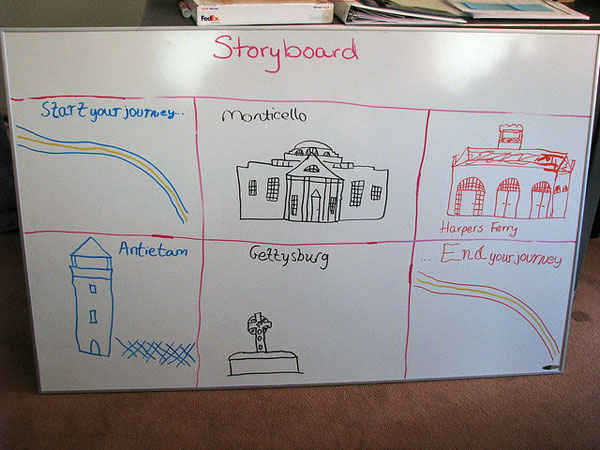
I spoke to See Jane Write last week about the Power of Storytelling.
Over on Y’all Connect, I turned it into a three-part series:
- Part 1: What is your story?
- Part 2: How do you tell your story?
- Part 3: How do you monetize it?
Note: Part 3 will be published on Tuesday.
Photo: npslibrarian (CC)
• • •
Discover more ways to communicate
with your audience …
Slides: “How to run promotional campaigns and build your list using WordPress”
Tonight, I’m giving this presentation on “How to run promotional campaigns and build your list using WordPress” for the WordPress Birmingham Meetup. (You still have time to RSVP for this free meeting, taking place at 7 p.m. at Pale Eddie’s Pour House.)
It’s based on my recent book launch for “The Social Media Stars of Birmingham.” (Download a copy of the book for free.)
In my talk, I’ll explain how I grew site traffic by a factor of eight for Y’all Connect and grew a new mailing list so fast that I saved years in the process.
1. You can see the slides from the presentation. Please feel free to download them or embed them on your site. To download a PDF, click the button marked “slideshare,” then “Save.”
2. I’ll post audio to sync with the slides.
3. If you want to stay in touch …
- You can contact me through this simple form. Please feel free to ask questions, make suggestions or request help.
- You can follow me on Twitter at @WadeOnTweets.
- You can subscribe to the free e-mail newsletter with tips, info, specials and more.
- And you can subscribe to my Birmingham Blogging Academy posts by RSS feed or by e-mail by looking for the box in the right sidebar.
Thanks for checking out “How to run promotional campaigns and build your list using WordPress.”
• • •
If you need help with digital marketing,
book me for a FREE consultation.
 One aspect I love about social media is how each person, each company, goes about using it. Some use it for entertainment, others for interaction or marketing.
I’ve written a book that shows who’s doing it well. And it’s free.
“The Social Media Stars of Birmingham” includes not only my picks but also their picks as well. You’ll meet 37 people and brands making Facebook, Twitter, Pinterest, Instagram, blogs and other digital hangouts into interesting and lively places.
I hope you enjoy the book. Download a copy, and let me know what you think.
•
Get your copy of “The Social Media Stars of Birmingham”
from Y’all Connect …

The squeaky wheels of Facebook

A reporter called me last week to talk about Facebook. Specifically, how a company can stand out by responding to customers online.
The Montgomery Advertiser ran the story Sunday with the headline, “Reshaping service: Local businesses, customers look to online comments, reviews on Facebook.”
We talked at length about how companies fare on Facebook, depending on their products and services but also on how they fulfill customers’ needs.
Allow me to go into detail, beyond what was covered in the article.
No matter the size of your company, Facebook fans and customers will perceive its “humanness” based on how it operates its page. It can be done with great care and love, or it can be done mechanically. Or in many cases, it has already been abandoned.
Customer complaints are nothing new, but companies that ignore them tend to be viewed negatively. The attempt to address those problems is important. No company can solve every single issue raised by customers, but the ones who make a good faith effort to respond to the most common or most important concerns can stand out.
One basic need we have is to be heard. Some companies ignore critical feedback, or even worse, delete it outright. What a missed opportunity to at least acknowledge a customer has taken time to write out a complaint.
Those businesses that take the next step, acting on feedback, are rare indeed. It is not easy to change or to fix problems within an organization. It could take an unknown amount of time and resources.
However, the companies that solve their customers’ problems are likely to win them for life. Facebook provides a conduit into how people really see your products and services, faults and all.
Facebook also provides a way for companies to demonstrate how they’re listening to and acting upon consumer complaints.
As someone who has built, modified and run Facebook pages for brands, I know that the value in having this channel is to invite all feedback and use it wisely.
Photo: Dell (CC)
• • •
Need help with your company’s Facebook page?
Contact me today for training and strategy.
Do everything wrong and backwards

I missed sending out an email newsletter last week.
I wrote a blog post that was 2,500 words long.
I rarely plan out my blog posts in advance (save for the one above).
I waste time on social media though I know I can’t spare it.
Is this any way to run all things digital?
Maybe. It’s the way I run things on occasion.
I tell people how to blog and how to use their social media channels. They listen, and often, they follow through. I am not a perfect coach, and they are not perfect operatives.
But we all muddle through. Even though it’s not all planned out, or that everything matches up to steps in the plan. Even though critics and fans will tell you you’re doing it wrong.
I am a big fan of results-driven work. Sure, I like efficient and practical methods. But I love great results. So my way isn’t always the best way for every single brand and company and campaign.
I do like to recommend alternate options. It’s part of building a strategy.
And I do like making progress, as uneven as it can be at times.
You don’t have to be perfect. You don’t even have to be great.
Know how your digital marketing efforts fit into your larger marketing picture. Measure what you’re doing in terms of reach and effectiveness. Adjust your tactics accordingly.
And know that however perfectly you’re doing it, you’re doing it wrong in someone’s eyes. Do it anyway.
Photo: Mark Ou (CC)
• • •
Save up to $50 (yes, $50!) on Y’all Connect passes.
Look for discount codes in my newsletter …
What I do for a living

When I say each of my sites is a work in progress, I’m not kidding.
This site has been up for more than 4 years, but one critical piece was missing.
My list of services.
I have corrected that oversight, and now visitors can actually find out what I do for a living.
See my list of services.
Photo: Judi Knight (CC)
Video: Wade Kwon on “How to Win Awards and Influence Readers
in 439 Days and 668 Posts”
I am a lucky presenter.
In March at WordCamp Atlanta, I received more than few shout outs on Twitter for my talk, “How to Win Awards and Influence Readers in 439 Days and 668 Posts.”
I never expected to receive a great tweet the same day my presentation video hit the Web.
David Scott Lynn, a yoga instructor in Phoenix, found my 45-minute video on WordPress.tv before I did and watched it. I am grateful when anyone will sit longer than 60 seconds to watch a video, much less mine.
While I’ll be reviewing the video to improve my delivery, you should watch it to discover the secrets of successful content marketing and management for the long haul. Let me know what you think, whether by telling me on Twitter at @WadeOnTweets or in a comment below.
- Slides from my presentation (which you can follow along in another window, download or print)
- See more videos of sessions from WordCamp Atlanta 2013.
• • •
I help companies from accounting to zoos.
Let me help with your digital content.
The go-to guy for media

I’ve been on both sides of journalism: the reporter and the subject. My ties with media outlets have helped me, my company and my clients talk with audiences they might not normally reach.
It makes me the go-to guy.
You want to be the media’s go-to guy for specific topics. Mine are social media, blogging, technology, trends and communication. My friend (and client) Jen Barnett, co-founder of Freshfully, is the go-to girl for farming, food, agriculture, produce, technology and entrepreurism.
You become the go-to guy when you provide quotes and soundbites on a regular basis to media outlets, helping reporters tell a story to their audiences. You answer their calls and texts and show up on time and ready to answer questions. You provide them with other sources and make them look good with their editors and directors and viewers and readers.
You send them media releases on a regular basis and feed them a steady diet of ideas, tips and the occasional bit of gossip.
You practice your interview skills ahead of time and help them understand complex topics quickly.
You build good relationships over time so they can depend on you on tight deadlines.
Being the go-to guy means waiting patiently. You may pitch ideas and interviews for weeks and months with zero nibbles. And then, you get a surprise call to go on camera, as happened to me last week. (See my interview on Fox 6.)
The go-to guy is flexible and energetic, knowledgeable and humble, with just a hint of swagger.
And in building media relations, the go-to guy isn’t known only to the media but to the community as well.
Photo: Chris (CC)
• • •
Looking for more tips on working with the media?
Subscribe to my weekly newsletter.
Book it: a scavenger hunt on social media
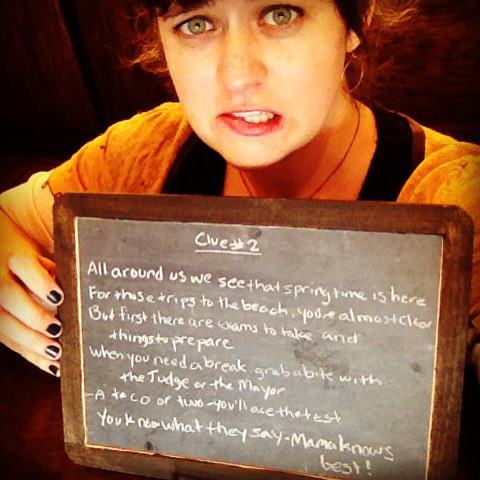
Church Street Coffee and Books co-owner Carrie Rollwagen
shares a scavenger hunt clue through a photo
posted on the store’s Facebook page.
Business owners who not only use social media but also add creativity and excitement to it can be a rare breed.
My friend Carrie Rollwagen found a great way to promote World Book Night as well as a culture of reading and her bookstore, Church Street Coffee and Books: a social media scavenger hunt.
This week, the Birmingham retailer is giving away books at other locally owned stores, kicking off the contest on its blog. The staff shares clues on their Facebook and Twitter (@81churchstreet) accounts.
Clever partipants who use the clues to visit the correct locations will receive free books and vouchers for other giveaways.
Plus, the store itself is offering mystery discounts and prizes through a unique plan: Customers can scan books on the shelves with smartphones to uncover the discount (10 percent to 50 percent off) or a prize (free coffee or cookie).
The promotion has earned media and blog coverage.
Church Street built the event around tonight’s World Book Night, an annual worldwide giveaway of classic and modern books by volunteers. (I’ll be giving away free copies of “Moneyball” this morning at 8:30 a.m. at Urban Standard downtown and tonight at 5 at World of Beer on Southside.)
- Stories in al.com | Head/Subhead | Village Living | Weld for Birmingham
• • •
How can your company build excitement through social media?
Contact me to build an outstanding strategy.
How to curate and crowdsource conference coverage

I’m looking forward to returning to PodCamp Nashville in a few weeks. When I went for my first time in 2012, I went all out in covering my experience at the new media conference.
Using Storify and Pinterest, I gave both a narrow first-person perspective as well as a comprehensive look at the event. Crowdsourcing and curation became my most effective methods for gathering and sharing material.
Take a look at my guide to conference coverage in social media along with the end results on the Y’all Connect blog.
Photo: Hamed Saber (CC)
• • •
Looking for conferences, seminars and networking events?
Find the best in my weekly newsletter.
The writer’s unfair advantage in social media

1. A writer can condense someone else’s blog post (article, gallery, video) into a withering tweet. [tweet this]
2. A writer embraces the unknown: unfamiliar topics, uncertain rewards, fickle audiences. [tweet this]
3. Even in viral photos, someone is writing all those Grumpy Cat captions. [tweet this]
4. A writer finds sick pleasure in tightening, revising, tweaking and scrapping two-sentence updates. [tweet this]
5. #badpun #ironictwist #winkandanod #micropunchline #lehashtagjuste #iamsoclever [tweet this]
6. A writer remains undaunted by saying something original in a sea of mediocrity. [tweet this]
7. A writer inspires readers to respond, to act, to share. [tweet this]
8. A writer creates social media updates from nothing, on deadline, without inspiration, every day. [tweet this]
9. A writer makes social media look effortless, while exerting maximum effort. [tweet this]
10. A writer leaves fans always wanting more. [tweet this]
Photo: Dragonlord878 (CC)
•
The writer’s unfair advantage in digital everything
Wade Kwon’s 34 rules for writing
•
Learn social media storytelling
from the best at Y’all Connect on July 23.
Adventures in community building
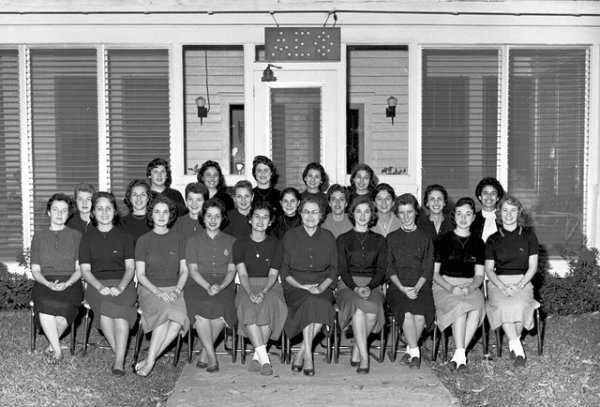
We all live in communities, whether we participate in them or not.
I’ve built communities online for years. The first one I ever created was a mailing list for my alumni of my high school.
The most recent one I’ve launched is a Google+ community for my hometown, Birmingham. I wanted to experiment with the new feature in G+, and Birmingham is always a good fit for me.
I like watching how others build communities, whether based on existing brands or willing them into existence.
Blogs have a unique relationship with the community concept. They can be communities, when they attract and engage visitors. They can spawn communities, whether in forums or on social media channels.
Bloggers often ask themselves whether their blog needs a related Facebook page, Pinterest board or Instagram account. The challenge with each new community is addressing the needs of its specific audience and finding time to work with it.
The advantages include expanding a site’s audience and reach, gaining new ideas and customers, and becoming better attuned to what fans like and need. The disadvantages include faster burnout, divergence from the brand and the occasional dead end (a community in decline).
The outcome I wanted to see on the Birmingham G+ community is starting to take shape: participation by members. Rather than just one person (me) feeding posts into the group, I’d like to see others contribute links, stories, photos, videos and comments about the city. This diversity of input makes for a richer, more engaging community.
Starting online communities can be done almost instantly. Nurturing and growing them remains the challenge for builders, but those who do it well find a common cause that quickly attracts like-minded participants.
Photo: UF Digital Collections (CC)
• • •
Looking to build community around your brand?
Let’s work together on it.
Pay attention: How I’m listening to improve my communication
A friend asked me recently about my best quality.
I’m not sure what it is, but I know what I’d like it to be: a good listener.
 Much of my ongoing pursuit of self-improvement has been on focus of late. I believe that becoming better at listening is absolutely essential in that mission.
I’m guilty of not listening well at times: letting my mind wander (an introvert’s favorite diversionary tactic), checking my phone during meetings and presentations, becoming distracted, trying to multitask. Have you done these things? Are they making you miss out on something important happening right now in front of you?
On becoming a better listener, I include visual as well as aural. In reading messages, emails and blog comments, am I paying attention to what someone is trying to tell me? Or am I skimming through it and carelessly creating miscommunication?
Perhaps at the core of my motivation for listening is the Golden Rule: Am I listening to others as I would have them listen to me? Certainly for me, nothing is more flattering than an attentive audience, even an audience of one.
I have been slowly improving my listening skills in three ways.
1. Zero interruptions. I can appreciate how frustrating it must be for you to tell me an important story, only to have me interrupt your flow. I will acknowledge that I am still paying attention with an “mm-hmm” or a nod, but I’d rather let you speak unimpeded.
2. Repeating back what you said. I will occasionally summarize your points or your argument for two reasons. First, I want to make sure you know I’ve paid attention. Second, I want to ensure that I’ve received your information accurately. If I repeat it back incorrectly, you can straighten me out on the spot. This can be an important tool for a reporter.
At the very least, I repeat back what you said in my head, to improve comprehension.
3. Asking good followup questions. If I really want to put my listening skills to the test, I’ll ask questions that get to the heart of the matter. By digging deeper, I can better understand your concerns and your message. This means paying attention not only to words, but to tone, facial expression and connotation.
I will sometimes unintentionally bury my true meaning through poor phrasing or wandering answers. A good listener will ask me a question that puts me back on track, which I appreciate greatly.
These three techniques help me learn more from the people around me. They save time in the long run from costly mistakes and preventable misunderstanding.
And they help me focus on the moment, rather than any other place or time in the universe.
The world is a more interesting place when I’m paying attention to what it’s trying to tell me.
Photo: James Vaughan (CC)
• • •
Learn to communicate better through my weekly email newsletter.
Subscribe today.


 Birmingham Blogging Academy