I remember when we all saw it on YouTube …
Video: Amanda Todd tells her story through handwritten note cards.
Saturday, I watched an intense teen drama with a tragic ending.
Sunday, I watched an adventure show with a stunt that had me on the edge of my seat.
I don’t have cable. I have YouTube.
This is becoming the norm, not just for me, but for wired citizens worldwide. I happened to watch on my laptop and my TV set, but many others tuned in via smartphone and tablet. Advertisers buy TV spots to reach mass markets, but the masses have quickly added YouTube to their daily viewing.
The teen drama came from 15-year-old Amanda Todd, who told her story without saying a word. Bullied at school and online by other students, she narrates her story through handwritten cards, accompanied by two songs. Very effective, heartbreaking and moving.
Her classmates beat her, taunt her to her face, mock her on Facebook and through texts. Amanda moves, only to find more bullies. She suffers from anxiety and depression, cuts her arm and cries from misery and loneliness.
Last week, she was found dead at home, of apparent suicide. By the way, this wasn’t a fictional Web series: This was the untimely death of a real-life Vancouver teen.
(Note: If you’re considering suicide, or have suicidal thoughts, please talk to someone. You can call the National Suicide Prevention Lifeline at (800) 273-8255.)
Her YouTube video has close to 4 million views. Watching it, I remembered how it felt to be picked on as a nerd and a “foreigner.” I also recalled how I bullied some classmates with my words, something I regret deeply.
Amanda, we failed you when you needed us. I hope you are at peace.
•
I saw a man jump from a tiny space capsule 24 miles in the air on Sunday.
It was the talk around watercoolers on Monday, though when I asked my friend Jen if she saw it, she said, “Well, I saw the GIF.”
Felix Baumgartner floated up in his capsule carried aloft by a helium balloon 424 feet in diameter (a standard hot air balloon is about 50 to 60 feet in diameter). He reached an altitude of 128,000 feet in 2 hours, then stepped out. At one point, he was traveling 833 miles per hour, breaking the sound barrier.
The spacesuited daredevil landed safely via parachute 23 miles away from his launch point in the Roswell, N.M., desert.
More than 8 million people watched live on YouTube, an audience bigger than the ones for most of Friday’s network prime time shows.
Watching him take that leap was inspiring and absolutely terrifying. I get dizzy halfway up a ladder. Our generation has grown up with Big Moments on TV: the Space Shuttle explosion, the tearing down of the Berlin Wall, “Ice Ice Baby.” That those moments have migrated to digital streams broadens the audience, but also makes them feel more disposable.
Maybe it was merely a 3-hour commercial for sponsor Red Bull.
But it certainly raised the bar for 3-hour commercials. I watched attentively and talked about it with others online and off.
The old model, which still works well for those who can afford it, is to buy airtime on TV channels to tell 30- and 60- second stories. The new model is that each of us, whether on our own or with a mega-corporation, can broadcast our stories on YouTube for free.
Those videos can be short or long, slick or raw, highly personal or broad and communal. They can bring us to tears, make us leap out of our seats or compel us to take action.
I saw the best and the worst of humanity this weekend. All through the same tiny window.
Video: Highlights from Felix Baumgartner’s record-breaking 24-mile-high space jump
• • •
What’s a storyboard, and how can it help your
video storytelling? Let’s work together on one.

Make a perfect blog post more perfect

I want all my blog posts to be perfect. It’s a strength and a sickness.
Perfection is a killer, though. Wasting time making everything perfect means never hitting the Publish button.
But in 7 years of blogging — not to mention decades of writing, editing, publishing and coaching — I do know how to make posts as close to perfect as possible. And it costs but a minute or two extra.
Taking a little more time means getting closer to perfection. The audience will remember those posts for a long time and share them with so many others.
1. Have a relevant, eye-catching visual. It took me less than a minute to find the Creative Commons licensed image above, suitable for commercial work.
I’m a little disappointed when I find a blog post without a photo, an illustration or a graphic. I love words as only a writer can, but I crave imagery to help things stick in my brain.
I made it easy to blog 30 days straight in September because I had a simple repeating visual to use in my new personal site, Project Bulk: topless photos of me.
2. Embed a video, a document, a photo, even a tweet. One of WordPress’ greatest shortcuts, and one that not everyone knows about.
Paste a URL into the blog post: a YouTube video, a document from Scribd, a favorite tweet. Instant embedding, instant multimedia.
•
This Flickr photo URL …
http://www.flickr.com/photos/jcknight/6838340551/
… turns into this photo of me by Judi Knight.
http://www.flickr.com/photos/jcknight/6838340551/
•
This Scribd URL …
http://www.scribd.com/doc/24990408/Schedule-Revised-1
… shows a schedule with my presentation on it.
http://www.scribd.com/doc/24990408/Schedule-Revised-1
•
This Twitter URL …
http://twitter.com/WadeOnTweets/status/253684266901331968
.. shows one of my popular tweets from the past week.
•
It took less than a minute to find each of these examples. WordPress offers 16 official types of embeds, and that list is growing.
Even without the shortcut, any digital item with its own embed code can almost always be embedded within a blog post. For example, I put sample ballots in my Election Day 2012 preview which can be magnified, downloaded, printed, even embedded elsewhere. And I included a video of a TV news report on an upcoming bond referendum.
Tip: I didn’t create all this rich content, but I reap the benefits from embedding it. It’s like having millions of creative, smart, energetic people on my blogging team.
3. Add tags. Tags describe a post’s keywords to readers and to search engines.
I wrote 16 tags for this post in about 30 seconds.
Tip: I use tags to help me in final editing. As I write the tags after the post is finished, I often discover that I forgot to include something important. It’s a reminder of any loose ends or even big points that warrant additional writing.
4. Edit the work. Take a breath. Read over the post. Use the built-in spellcheck. Read it aloud. Email it to a friend.
I’ve had mistakes published in print on the simplest of jobs, such as a poster with 20 words, because no one edited it.
This editing process includes the headline. This includes the photo captions. This includes the tags. Careful editing shows care for the readers’ time and enjoyment.
It takes an extra 2 to 15 minutes, depending on the length and complexity of the post. I often spend far more time editing than writing.
I’ll say it again: It takes years to build a reputation and only seconds to destroy it. Edit as though your reputation hangs on every single word.
5. Update the post as needed. If I discover new information, and it merits attention, I will add it to the post. If a reader leaves a comment that answers an important question, I will also add it to the post.
I do so transparently, meaning that the new information is clearly delineated from the original text in the post. For example, I wrote an essay last week about the historic changes at the Birmingham News and al.com. After learning about four new related items, I added them to the end.
It took about 5 minutes total for the updates. And each update gave me something new to promote, which leads to …
6. Promote like crazy. My damn-near-perfect posts will not lie dormant online. I will plug them through my email newsletter, my social media channels, my sites, my media releases, my media appearances, my business cards, my emails and myself. I work hard to make sure the posts deserve readers’ time and attention, so it’s up to me to make them highly visible. I will wring as much juice as I can from them.
I linked to four of them above. I tweeted out a link to a post from 7 years ago on Saturday.
I will share today’s post for days and weeks and months and years to come. Count on it. Promotion is built into my daily routine, so the time is already allotted.
I may not ever achieve perfection in a blog post, but that will never stop me from trying.
Photo: Andy (CC)
• • •
Want one-on-one help to make your company blog perfect?
Contact me today for a free consultation.
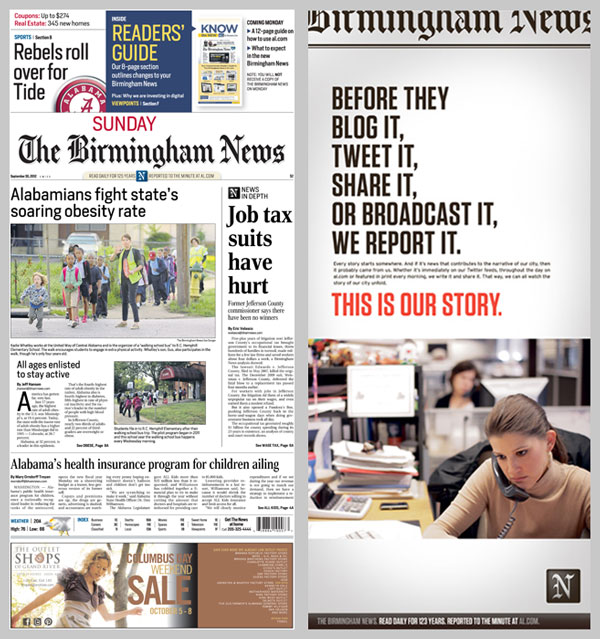
The Birmingham News: final daily front page from Sept. 30, 2012,
print ad from 2011 branding campaign.
I’ve been away from the daily newspaper biz some 7 years and 1 week. Mighty strange things have happened since I left that scene in Birmingham.
Today marks a new era for my hometown, one in which both newspapers I grew up with are no more. In their place is a new three-times-a-week publication with a familiar name, the Birmingham News.
It is a topsy-turvy world when you realize that the Crimson White, a student-run newspaper down the road at the University of Alabama, publishes more frequently. Or that any number of smaller towns in Alabama still throw papers 6 or 7 days a week: Anniston, Cullman, Decatur, Dothan, Florence, Gadsden, Montgomery, Opelika, Selma and Tuscaloosa.
Or that of the three papers in Alabama shouldering this downsizing wrought by owner Advance Publications (Huntsville and Mobile being the other two), Birmingham was the only one to see a jump in Sunday circulation, a healthy 13 percent increase from March 2011 to March 2012.
And yet Birmingham becomes the second largest city in America without a daily newspaper. New Orleans, which has seen its fair share of hardships, is the largest. Her citizens, business leaders and politicians have rallied to save, even offer to buy, the Times-Picayune, but to no avail. Our city has resigned herself to muddle along as always.
The News has a long and storied history in its 124 years. (I even worked there as a metro reporter for a short period early in my career.) But you can no longer read about it on the newspaper’s discontinued web site; it has been downsized as well to a brisk 127 words on the shiny new Alabama Media Group site.
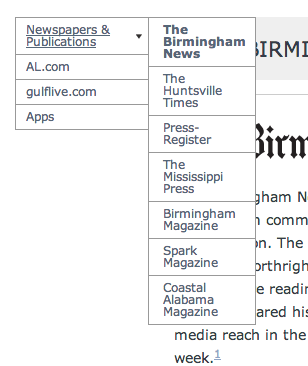 There you will find the News sandwiched in between all the other properties, be they site, app, mag or rag. Those seeking a more detailed rendition of the newspaper’s back story must rely on the Wikipedia entry or the ever-dependable Bhamwiki.
Don’t bother looking for a list of reporters and photographers. It’s long gone, save for the copy I made to report on the 100-plus firings. Know that in the current mix of employees, some are old hands, some are al.com staffers and the rest are newbies. (And all staff members are now using al.com email addresses, another kiss-off to bhamnews.com, their former domain.)
A long-standing community voice will have to make do with its widely derided web site and three editions a week. Unlike New Orleans, no outlet or blog or billionaire has rushed to fill the ever-growing void of daily, in-depth reporting and investigation that keeps leaders somewhat honest and the public somewhat informed.
I look at the media and no longer miss the heady days in the newsroom. Where once my beloved Post-Herald stood is now a parking lot.
I’ve been away for many years, but some days, not long enough.
•
Update Oct. 3: Don Keith reviews the new Birmingham News Wednesday print edition: “The Birmingham News is stumbling right out of the block.”
Also …
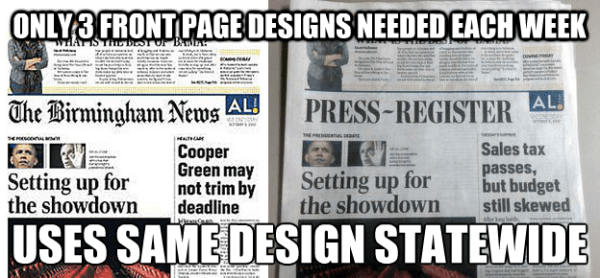
The front pages for the Birmingham News, (Mobile) Press-Register and presumably the Huntsville Times shared the same design for the debut Oct. 3 print edition. Surprising, given that each paper now only has three editions to design every week and more time to do so.
Freelance journalist Charles Apple says: “This lead package is gorgeous.”
Update Oct. 4: Bob Sims, director of community news at Alabama Media Group, spoke to the first edition at a local forum:
Update Nov. 13: Because Baton Rouge-based newspaper The Advocate is publishing a New Orleans edition 7 days a week, this makes Birmingham the largest city without a daily newspaper. The Tuscaloosa News has also started daily delivery in Birmingham, but no special edition. Nitpick: Baton Rouge is 80 miles away from New Orleans — does it still count as local?
• • •
All the communication news that’s fit to print.
Still once a week, straight to your Inbox.

My communications credo

What you put inside is your message. Make it museum-worthy.
Everything I do in communication comes from this set of principles. Everything.
Follow up with people. Preferably within 24 to 48 hours.
Don’t worry about losing followers (subscribers, commenters, etc.). Focus on sharing things that are informative, interesting or funny. You will gain more than you lose over time.
What does this story (tweet, blog post, email, infographic) mean to the reader? Always stay focused on the audience.
Listen carefully. Don’t interrupt.
Be yourself. People will either accept you or reject you, but the latter won’t kill you.
Have something to say. Blogging (tweeting, talking) for the sake of blogging puts you in the mediocre majority.
Tell a story. A compelling story can be more attractive than a sermon, a screed or even a list (yes, even this one).
Be succinct. Respect your audience’s time.
Attribute, don’t steal. Summarize, don’t plagiarize. Link to appropriate material.
Edit carefully and thoroughly.
Practice presentations and speeches. Then practice some more. Then even more.
When speaking to an audience, connect with them through eye contact and interaction, not notes and slides.
When speaking to the media, take time to think out your answers. Don’t fear silence, even on live television or radio.
Thank people for their input, whether praise or criticism. They took time to think about your message and responded.
People are imperfect. Keep that in mind when others (or you) fall short in communicating effectively.
Photo: Bart Everson (CC)
•
What’s in your communications credo? Share your thoughts in the comments.
• • •
Working on your social media? Your public relations?
Your marketing campaign? Let me help you do it right.
The end of the phone era
Video: “Call Me Maybe” by Carly Rae Jepsen
The first day’s batch of the iPhone 5 sold out in hours online. The hit single of the summer was “Call Me Maybe” using the old-fashioned concept of calling someone.
How can it be that the phone era is over? Are phones going to end up like CB radios and telegraphs?
I mention it because while we all have phones, calling seems to be way down the list of ways we use them. Texting, Facebook messages, Twitter DMs (direct messages) and even email seem like better ways to reach others when left to our devices.
My tribute to the winding down of dialing up, with apologies to Carly Rae Jepsen.
•
Tell Me Maybe
 I bought a cell at the mall
Not sure that I’ll ever call
Just text me quick lol
And now the phone is dead.
I knew all the apps to buy
Ringtones and cases oh my
Why is the price so high?
And now the phone is dead.
Your call was waiting
Two lines, signal fading
On hold, music playing
Who you think you’re calling, baby?
Hey, I just pinged you, and this is lazy
But here’s my voicemail, so tell me maybe
It’s hard to talk right now baby
But here’s my voicemail, so tell me maybe.
Hey, I just pinged you, and this is lazy
But here’s my voicemail, so tell me maybe
And all the other calls try to reach me
But here’s my voicemail, so tell me maybe.
You took your time getting back
I had no minutes to yak
Too busy getting a snack
And now the phone is dead.
I hate to be on the line
Pick up … oh look at the time
An email would be just fine
And now the phone is dead.
Your call was waiting
Two lines, signal fading
On hold, music playing
Who you think you’re calling, baby?
Hey, I just pinged you, and this is lazy
But here’s my voicemail, so tell me maybe
It’s hard to talk right now baby
But here’s my voicemail, so tell me maybe.
Hey, I just pinged you, and this is lazy
But here’s my voicemail, so tell me maybe
And all the other calls try to reach me
But here’s my voicemail, so tell me maybe.
Before your call went to voicemail
I missed your email
I missed your email
I missed your long email.
Before your email went to spam
I missed your DM
I must’ve trashed them
I missed your last DM.
It’s hard to talk right now baby
But here’s my voicemail, so tell me maybe.
Hey, I just pinged you, and this is lazy
But here’s my voicemail, so tell me maybe
And all the other calls try to reach me
But here’s my voicemail, so tell me maybe.
Before your call went to voicemail
I missed your email
I missed your email
I missed your long email.
Before your email went to spam
I missed your DM
I must’ve trashed them
I missed your last DM.
So tell me maybe.
Video: “Call Me Maybe” instrumental version, in case you want to sing along
• • •
Follow or message me at @WadeOnTweets.
Tweet me maybe.

Popularity: the perks of pursuit
•
[Part 1: Popularity: the shiniest metric of all]
•
Popularity is power.
Our country runs on popularity, at every level from city council member all the way to the President of the United States (overlooking the Electoral College). Winning these popularity contests means controlling the government.
We spend a lot of time, money and brain power trying to make our brands popular. Being well known and well liked in the marketplace can mean bigger profits and less risk in the long run.
And we even spend time trying to become more popular online. Digital popularity has tangible benefits for people and organizations, but it can disappear quickly and lead us astray.
Let’s examine the upside to a large following …
Popularity lends an air of credibility. As much as we like to think social media democratizes all voices, not all are perceived as equal in authority. Lady Gaga is the queen of Twitter, with more than 29 million followers. Even if weed out the potential fakes, that still leaves more than 8 million followers.
When she tweets, many take it as gospel truth, even if others see her as a mere pop star.
That phenomenon may speak more to the rise of celebrity culture, but even us nobodies can grow a sizable following in social media and in email and blog subscribers. I’ve met many a mom whose opinion on anything from child’s backpack to luxury sedan carries considerable weight in her digital tribe.
Her expertise may be the foundation, but her popularity gives her substantial credibility among her peers.
Popularity extends message reach. We buy ads that will see the most traffic, whether online, in print, on a billboard or with viewers. Using a popular medium can translate into a bigger audience and, of course, a bigger bill from higher advertising rates.
It also makes it much easier to promote a cause. Marketing expert Mitch Joel has leveraged his popularity on his blog to raise money to fight cancer. In more than 3,000 posts, he has asked for something only three times. So far, he has raised nearly $9,000 from starting with a goal of $2,000.
Cultivating a bigger digital audience means spending less effort on getting a message out, whether it’s a product launch, a 3-day sale, a survey about consumer trends or a simple exercise in brand building. But it also means carefully crafting the right message. The bigger the audience, the more perfect that message must be.
Most of my digital friends keep up with me through Twitter, so I spend several hours a week crafting my tweets. I put care into those compact messages because I want them to reflect on me well and to share as much information as possible to help others.
Making those tiny statements as polished as possible ensures that they will be read, contemplated and shared. Thus, reach.
Video: U2 in an iPod ad
Popularity gives a halo effect. Having tremendous popularity makes someone cooler, taller and sexier. OK, maybe not, but they do get better treatment.
In “Steve Jobs” [aff. link], the popularity of the iPod makes for a tremendous marketing tool, not just for the device, but for the content in the iTunes Store and even for Macintosh computers.
The portable music player was so popular, it even flipped the celebrity endorsement model. For generations, movie stars and musicians hawked products for tons of money. Agencies and brands sought out popular icons to bring goods to the public.
The iPod’s promotion with Bob Dylan brought the legend a new, younger generation of music buyers who discovered him through the campaign. When U2 lead singer Bono realized this, he asked Apple and CEO Jobs to appear in the iPod commercial. For free. (The deal eventually included a percentage from the sale of limited edition U2 iPods.) Other artists also volunteered to be in the ads to get that halo effect: more sales, a hipper image, younger fans.
That halo extends to digital popularity, too. Bigger audiences can help spread the word, but they can also forgive mistakes, defend from detractors and gather information. (Crowdsourcing fails without a crowd, no?)
Chasing popularity can reap great rewards. In the end, the quality of followers matters more than the quantity, but no one says we can’t have both.
Photo: Scott Mucci (CC)
• • •
Want to learn more about building your digital popularity?
Sign up for our e-newsletter today!
Popularity: the shiniest metric of all

•
[Part 2: Popularity: the perks of pursuit]
•
In working with clients on the sometimes confusing area of metrics, I show them how popularity can guide decisions.
But popularity has a dark side. It whispers to our vanity and seduces us into pursuing it instead of excellence.
Popularity can be bought. Customers often judge the quality of a product based on its popularity. Given the choice between two items of the same price, a shopper might pick the one with the bigger following.
In digital marketing, the brand with the crowd on its side might actually be very unpopular.
For example, Twitter users can buy thousands of followers for a few dollars. These fake followers never tweet, never follow anyone else. They create an aura of popularity around anyone willing to pay the price and break the rules.
The scary part is that an unscrupulous person could also buy thousands of followers for anyone else’s Twitter account in a means to discredit that user (the potential to be one of the dirtiest campaign tricks available online, my pal Ike Pigott suggested).
And when potential customers see that inflated follower count, they may choose that brand, company or person without checking to see from where that popularity came. Is a buyer getting the real deal or a mere pretender?
(This is how companies select consultants, speakers and experts, so I have an obvious stake in weeding out the con artists.)
StatusPeople, a social media management company, has a new tool that samples followers in Twitter accounts to determine how many are real or fake. The free Fake Follower Check requires a Twitter account and a takes only a few seconds to report results.
For my account @WadeOnTweets, it reports that of my 4,562 followers, 2 percent are fake, 10 percent are inactive, and 88 percent are good.

Having an audience of fakes is like playing a concert to thousands of cardboard cutouts in Carnegie Hall. But to the uninformed, it looks like a sold-out performance.
Popularity inflates egos. Companies and people with big followings sometimes get big egos as well. After all, if thousands of people hang on our every word and blog post and tweet, we must be very important, right?
The buzzword these days is influence, a fancy way of saying “popular.” After all, a guru can’t have influence over followers without popularity at the core. The silliness of popularity has its origin in the social shark tank of high school. We are all conditioned to some degree by those teenage years keeping score of who’s up and who’s down.
That silliness has manifested itself in the adult world as Klout, a service that purports to measure digital influence though an often-changing formula. I could announce that my Klout score is 64.41, but that number has no meaning, even if compared to other scores. It’s no more helpful than announcing my E-meter reading is φ4J.
And yet, researchers and marketers make a tremendous effort to quantify influence and popularity. Is it rooted in the number of followers, the number of retweets, the time spent on site or the click rate? Is the person who influences a small set of power brokers more popular than another person who holds sway over a million “nobodies”?
The problem isn’t necessarily who’s most popular. The problem is when a person’s (or a company’s) sense of popularity overwhelms common sense. It leads to lazy thinking. It leads to as sense of “Everyone thinks I’m right and so … I must be right.”
That can be a disastrous poison. The antidote is humility, always. (And in my case, some self-deprecation, too.) And for good measure, skepticism can be helpful, too.
Popularity shouldn’t be equated with level of quality. Or, what is popular isn’t always what is best (and vice versa).
The most popular post on this site (or on any of my sites) isn’t necessarily my best post. It may be the most unique one in terms of SEO traffic and keywords. It may be the luckiest post in terms of timing and subject.
Birmingham Magazine recently published its Best of Birmingham 2012 poll results. In this case, best is clearly in the eyes of the beholder. As it was in 2011 and 2010, when I won Best Tweeter.
Did I actually think I was the best then? No. I said James Spann (@spann), meteorologist for ABC 33/40, was and is the best tweeter. And he won the category this year, deservedly so. Do I think I’m the worst tweeter because I didn’t show up on the list? No, of course not.
My value as a tweeter isn’t rooted in this or any other popularity contest. It’s flattering when I win, but the real value comes from sharing interesting, informative or funny stuff every day. Each follower has her own perception of the value of those daily tweets from me. If the perceived value goes down, she unfollows.
Having run my fair share of readers’ polls over the years, I know first-hand that what is popular isn’t always what’s best. Some companies stuff the ballot box themselves, or beg their followers to vote on their behalf. If they feel their reputation needs such a severe ego boost, not much can be done to stop the campaigning.
But popularity, even earned popularity, can be fleeting. What crowds adore today can easily be ignored tomorrow in this disposable culture.
Chasing popularity often means sacrificing the pursuit of enduring excellence. That misguided choice can do a lot more damage in the long run than just a bruised ego.
Photo: kismihok (CC)
• • •
Need help with sorting out your metrics?
Contact me today for a free consultation.
How to win at blogging, when you don’t care about winning

Nick Saban is my hero.
He’s my hero for the same reason that he may be your most despised enemy: He coaches the top college football team in America, Alabama. He has won two of the last three national championships with the Crimson Tide (and three of the last nine including one at LSU).
But this is not about Nick Saban, the football coach. This is about Nick Saban, the guy stuck in a rut.
A lot of people wish they were stuck in Saban’s rut (not dirty!). He has a system for winning in which victory is almost an accidental byproduct, a zenlike state of dominating other teams on the field.
The Process is not unlike how I’ve had great success at blogging, and you can, too.
Saban emphasizes focus on knowing your role and practicing the skills vital to your role. It is a micro-focus rather than a macro-focus.
What’s somewhat incongruent for me is a lack of goals. His goal is to have everyone know their role and perform it with precision and consistency. I like long-term goals to help determine timelines and strategy.
But, you can succeed in blogging, even without a goal.
My Process for blogging is straightforward and seemingly easy to duplicate. (Hmm, should this be a 31-day series?)
- Have a great platform. Nothing holds you back like unease with trying to post or a bug-filled system. I rely on WordPress to do its job smoothly so I can do mine.
- Have something great to say. Whether it’s informative, interesting or entertaining, I can rely on either an editorial calendar or an idea list to share ideas on the best topics. This includes my newsletter and my social channels, too.
- Share your posts consistently. No automation here. I always work hard to share my latest work (and my archived posts, too!) with my friends, via email, social media, business card and in person.
- Engage everyone. Using my digital listening skills, I watch reaction to my posts. This includes comments on the post, links and trackbacks and social media mentions. I work hard to talk with people and follow up on their questions.
- Measure everything. Tracking your traffic and other statistics can keep you on track to improve with each step.
Saban believes the Process creates its own successes through excellence in execution. It’s about winning the down, the drive, the quarter, the half, the game and repeat. Take care of those things, and a championship can happen.
So if you copy my Process, focus on the next topic, the next post, the next photo, the next series, the next email newsletter. Consistency and high quality can reap rewards such as more comments, more traffic, more clicks, more subscribers, more leads, more sales and more opportunities.
Recruit well for your blogging team, give them the tools and training they need to fulfill their roles. Even if you don’t care about winning, you’ll earn victory through greatness.
Even without a goal. Even without Nick Saban.
•
Additional reading:
- Nick Saban’s Process, with lessons on leadership and success
- Posts on blogging
• • •
Want to put the Process in place?
Recruit me today to help your team become No. 1.
Beyond the numbers: Feedback from a friend

My newsletters, from August 2011, left, and August 2012
I preach numbers, but sometimes, I lose my way. But lunch with a friend last week helped me see beyond my myopia.
Jen Barnett and I have long traded advice and cheered each other on in career and in life. I’m grateful for her words of wisdom as we left the restaurant.
As a fellow small business owner, she knows the challenges of seeing the big picture. But she looks as each day’s progress as adding value to her company.
And then she turned it on me. “Look at how much you’ve built over the last few years.
“Go look at a newsletter from a year ago and see how much you’ve improved.”
I didn’t have to look. Her kind sentiment alone made my day.
I have been lost in the weeds. I can quote the open and click rates on my recent newsletters, or analyze my recent speaking performance, but a friendly personal assessment can mean as much or more.
When Jen, a newsletter artiste, says I’ve improved at it, that means something to me. It is high praise indeed.
Your communication channels could use a spot check. Examine your newsletters from a year ago. Or your blog posts. Or your videos. Look for growth and polish, style and substance. Each time we do something, we almost always get a little better at it.
But we forget, because we are in the middle of it. We are lost without a guide, a friendly voice.
And when assessing how you’re doing, consider going beyond the numbers. Ask your friend or your spouse or your readers. Listen carefully to their feedback, and incorporate what you can.
Numbers are important. As are kind words. Both can help you assess real progress over time.
•
Judge for yourself: Click each thumbnail to see the newsletter in full. Let me know in the comment what you like or dislike about each version.
 |
 |
| Aug. 8, 2011 | Aug. 13, 2012 |
• • •
Want to learn more about social media without leaving your Inbox?
Sign up for our e-newsletter today!
How to get 146 retweets on Twitter

America is a funny place. Seriously, you can never run out of material here.
In the middle of Chick-fil-A Appreciation Day on Wednesday, I threw out this observation about “slacktivism” on Twitter:
I’ve picked up retweets before, a few here, a few there. Some for humorous one-liners or for breaking news.
Never have I received so many retweets before, 146 and counting. (More, really, counting old-style cut-and-paste retweets.) It’s flattering. It’s weird.
I do have some guesses as to why this tweet took off …
- Timely. You can’t go wrong with focusing on what people are talking about. (Note: Be sensitive to what’s going on and how a poorly worded or poorly timed tweet can enrage rather than engage.)
- Unique. I had seen plenty of tweets about people supporting the restaurant or chiding it, but only a few discussing alternatives. (I like options, not either-or.) I’m a big proponent of civic activism, including the most basic form, voting. I found a way to express it in under 140 characters.
- Provocative. It certainly wasn’t an inflammatory position, but it did get people talking and debating. A few even challenged me on the numbers. That’s fair, but in the end, I got my point across to a wide audience.
- Highly visible. With 4,500 followers (most real, none bought) earned over 3 years, I have a great audience. If I tweet something, someone will see it no matter the time of day. And it will be in the big three of retweetability: interesting, informative or entertaining. It’s tough to pull this off with 10 Twitter followers.
- Self-contained. This unique tweet had no links or photos or @users or even hashtags. It was a simple short sentence. In this instance, less is more.

More metrics on my popular tweet via Buffer
It comes down to consistency in tweeting regularly, rather than once a month. It means having a personality and a point of view, not just auto-tweeting blog posts and Foursquare check-ins.
When you’re tweeting on behalf of your company, think about how to incorporate these aspects into your communication plan. How will you build your audience so your tweets are highly visible? What information or perspective can you share that’s unique? What are your followers talking about right now?
Then, tweet hard and regularly. (It applies to Facebook and LinkedIn updates, too.)
And don’t be chicken. No one wants to retweet someone who clucks up all the time.
•

• • •
Want to chat on Twitter with me?
Follow or message me at @WadeOnTweets.
Consultant’s diary: Winning the war on Pinterest
Social media strategist Ike Pigott once observed that using social media and third-party sites (like WordPress.com) can be like building on sand. All the work you put into something like your Facebook page can disappear in an instant.
So I found with my Pinterest account earlier this summer. The good news is I won an important battle. The better news is that as your consultant, I’ll do battle for you while you run your business.
My trouble with Pinterest started in June when I discovered I could no longer pin items to my board. In Facebook, you can passively look at items or you can update your status, share apps, play games, upload photos and videos and a whole lot more.
In Pinterest, all you can do is pin. (And Like, but it’s kinda lame.) You pin items from other sites, you re-pin cool things from your friends’ boards or you upload photos for new pins. That’s the ball game.
As a business owner, you never want to find yourself locked out of a critical function. Imagine if your sales run on calls, and the phone company decided last night to limit your calls to 911 only. Yikes.
My next step was to contact customer service. Pinterest uses Zendesk to process its service tickets, so I turned one in. Like many social media companies (and companies in general), Pinterest does a terrible job of listening and responding to customers.
(I had discovered this on a previous ticket trying to get one of my pinboards fixed. No responses after 30 days, even with reminder notes from me.)
I waited and waited and waited. Pinterest has no other way to reach them, not through other social media or even email or phone.
I made one last ditch effort. I wrote a letter to Ben Silbermann, founder and chief executive officer of Pinterest.
Maybe that did the trick, because a couple of weeks later, I received an email from the community manager. She had looked into both service tickets and explained what had happened. Sort of.
I still don’t know what put me in Pinterest jail, so I don’t know how to avoid the same fate. (I’ll email her to see if I can get clarification.) I cautiously tested the pinning, and it seems to be working normally again. Why I was limited in the first place, I may never know.
(My backup plan was drastic: Set up a new account and start over. Months of work reset with a frozen legacy account. Fortunately for me, it didn’t come to that.)
You, the busy professional or business owner, should not have to deal in the minutiae of how to block annoying people on your Facebook page or set up a Twitter widget. You should not have to write to Ben Silbermann to get a simple issue resolved.
That’s why I’m here. That’s what I do.
Because I’m never satisfied with mediocre. And because I will fight fight fight for you and your company.
For now, I pin. I find Pinterest a valuable tool to curate info, cover live events and explore trends. One battle down, many more to go.
- Follow Wade Kwon on Pinterest.
- More posts on Pinterest.
Illustration: Socially Sorted
• • •
Want to learn more about social media without leaving your Inbox?
Sign up for our e-newsletter today!
Everything you need to know about getting attention

Everything you need to know about getting attention comes down to two basic steps:
Tell a good story. Make it sharable.
Some of you have mediocre stories, ones that are somewhat interesting but not really worth checking out more than once. Some of you have fantastic stories, but they’re buried in brochures and PDF files and unfriendly websites.
Rising Wesleyan University senior Ben Doernberg found the story of bullied bus monitor so compelling, he created a post on Storify. This free tool makes it easy to piece together text, videos, tweets, photos and more. Those posts can then be shared through links and embedding.
The monitor, Karen Klein, endured verbal abuse from middle schoolers. Outraged netizens donated more than $650,000 to allow her to take a vacation, even retire.
Doernberg’s Storify post set a record, having now reached more than 3 million views. Making an embeddable multimedia story led to being included on the Huffington Post, which racked up 2.6 million views to date.
Tell a good story. Make it sharable.
• • •
Need help with telling your story to your customers
and the media? Contact me today for a free consultation.
 Birmingham blogger Rachel Callahan returns for a second guest post!
Her funny personal blog Grasping for Objectivity in My Subjective Life shares stories from her busy life as an accountant, a wife and a stay-at-home mom to two children.
She also created Alabama Bloggers, which features bloggers and their sites throughout the state.
Her post below digs deeper into Pinterest, giving you ways to access the numbers hidden until now. Learn how you can determine how and how much your blog posts are pinned on this social network.
•
By Rachel Callahan
Pinterest is one of the most powerful social networks for bloggers to date. However, it’s still a limited platform, especially when it comes to metrics.
The developers seem to be constantly monkeying with their coding and platforms, making it tricky to navigate and track with any degree of accuracy. Plus, Pinterest hasn’t released its API for developers to make third-party applications.
Being a stats geek who makes blogging decisions based on those statistics — I use StatCounter primarily, with Google Analytics in a far second — it annoys me that I can’t access my Pinterest metrics.
Fear not! I’ve shown you how to use images to help your blog posts stand out on Pinterest. Now, I’ve created three hacks to help you find your Pinterest stats: an easy hack, an intermediate one and a difficult one.
The Easy Hack: Your Pinterest Source Page
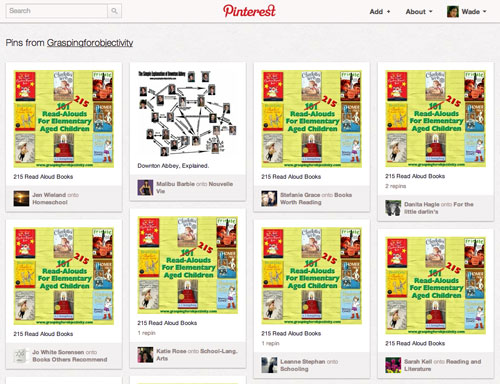
Pins for posts from Grasping for Objectivity in My Subjective Life
Every website featured on Pinterest has a source page which shows all of the first-tier pins from your site (no repins, though).
Second-tier pins, repins directly from the original pin, can be seen in a count underneath the photo. Third-tier pins and beyond are not visible from this page.
Example: If Annie pins something from your site, it will show up on your source page. If Betty then repins Annie’s pin, it will show up as a count under Annie’s original pin on your source page. If Carol repins Betty’s repin, you have no way of seeing that from this page.
- http://pinterest.com/source/yoursite.com
Examples:
- http://pinterest.com/source/graspingforobjectivity.com
- http://pinterest.com/source/birminghamblogging.com
- http://pinterest.com/source/jamiebg.blogspot.com
This hack can be unstable: Pinterest often delays updating these source pages, and last week, it limited the historical reach, showing the last few dozen pins from your site. Hopefully, this minor bug will be fixed soon.
Intermediate Hack: How to Get Your Pinterest Pin Count Back
The Pinterest “Pin It” Button is supposed to have the optional feature of displaying pin count. It’s the only way to see the comprehensive total of all pins on all tiers.
A few months ago, the code quit displaying those numbers. After studying the code, I figured out how to get the counts back.
1. Go to Pinterest’s Pin It Button Page.
- Scroll to the “Pin It Button for Websites” section.
- Enter the URL of your post, the URL of the image to be pinned and the pin description.
- Select “Horizontal” for the Pin Count drop-down box.

2. Copy the code it gives you, then go to your post and paste it into the HTML view. For example:
- URL of page to pin: http://www.graspingforobjectivity.com/2012/05/read-aloud.html
- URL of image to pin:
http://www.graspingforobjectivity.com/wp-content/uploads/2012/06/215-Read-Aloud-Books.jpg - Description: 215 Read Aloud Books!
The code is:
<a href="http://pinterest.com/pin/create/button/?url=http%3A%2F%2Fwww.graspingforobjectivity.com%2F2012%2F05%2Fread-aloud.html&media=http%3A%2F%2Fwww.graspingforobjectivity.com%2Fwp-content%2Fuploads%2F2012%2F06%2F215-Read-Aloud-Books.jpg&description=215%20Read%20Aloud%20Books!" class="pin-it-button" count-layout="horizontal"><img border="0" src="//assets.pinterest.com/images/PinExt.png" title="Pin It" /></a>
3. Add the following snippet to the end of that code:
<script type="text/javascript" src="http://assets.pinterest.com/js/pinit.js"></script>
This will include the pin count with your button.
Difficult Hack: Creating Your Own Pinterest Tracking Page
After studying the code to create the pin count hack, I realized that the HTML of the code wasn’t location dependent. That means you can place the Pin It button for a specific post on any page you like.
You can create your own Pinterest tracking page, showing pin counts for multiple posts in one location. I created a tracking page for all my pins.
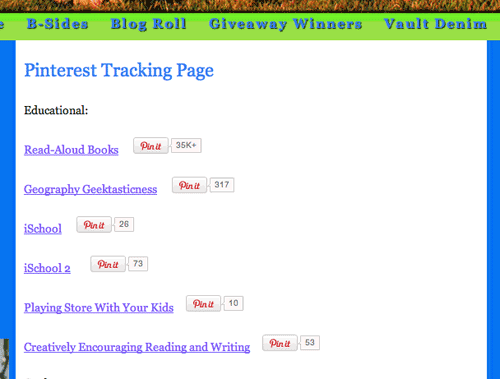
Grasping for Objectivity’s Pinterest Tracking Page
I copied the Pin It button code from each post and use them all on one page. For example:
<a href="www.graspingforobjectivity.com/2012/05/read-aloud.html">Read-Aloud Books</a>
<a class="pin-it-button" href="http://pinterest.com/pin/create/button/?url=http%3A%2F%2Fwww.graspingforobjectivity.com%2F2012%2F05%2Fread-aloud.html&media=http%3A%2F%2Fwww.graspingforobjectivity.com%2Fwp-content%2Fuploads%2F2012%2F05%2F101-Read-Aloud-Books.jpg&description=101%20Read%20Aloud%20Books!"> Pin It</a>
<script type="text/javascript" src="http://assets.pinterest.com/js/pinit.js"></script>
I can track pin counts for my favorite posts on one page. The downside is that the information is just a real-time snapshot: No Pinterest API means no (easy) way to collect this data over time.
Your only option is to plug in those numbers once a day, week or month in a spreadsheet.
•
If you have questions, comment below or email Rachel at graspingforobjectivity@gmail.com.
•
Rachel’s previous guest post: How Graphics Can Help You Win Awards and Go Viral
• • •
Follow Rachel online …
Twitter pet peeves, 2012 edition
Ah, Twitter. The free communication tool that can’t monetize itself or iron out all the bugs. I love it, and yet …
I’m going to limit myself to three Twitter pet peeves (though I want to hear yours).
- The unfollow bug. It’s been happening for months, possibly years: Users discover followers disconnecting from them. But not on purpose — it’s some kind of bug. Twitter admitted as much in March, but I’ll be damned if I can’t find an update.
- Scheduler error. Tweetdeck (now owned by Twitter, sigh) displays this message whenever users try to schedule tweets. The one problem that will drive loyal users like me to Hootsuite. Even worse? Trying to report the problem to Support and getting the run-around, even though this problem affects thousands of Web and app users.
- Spam tweets and DMs. An ongoing problem. Facebook has managed to eradicate most spammers, but on Twitter, they continue to thrive. I probably report five accounts a day.
It appears this company is squeezed in terms of trying to roll out features while also trying to fix the broken aspects.
https://twitter.com/SwagHazza/status/211557030551490560
Illustration: Opensource.com (CC)
•
What are your Twitter pet peeves? Sound off in the comments.
• • •
Want to chat on Twitter with me?
Follow or message me at @WadeOnTweets.
One of my favorite bloggers, Rachel Callahan, has stood out for her funny personal blog Grasping for Objectivity in My Subjective Life. She does a remarkable job of sharing insights in her busy life as an accountant, a wife and a stay-at-home mom to two children in Birmingham.
Rachel does an excellent job of building community, talking with readers and sharing her expertise and kindness with others. She also runs Alabama Bloggers, a networking site I visit regularly.
I’m thrilled to have her as my first guest blogger, as she shows how properly using images in blog posts can help your site gain traffic through Pinterest.
•
By Rachel Callahan
In the past three weeks, I was honored to win a major blogging award and write a post that has been pinned more than 20,000 times (so far) on Pinterest.
And I attribute both of those successes solely to creating my own graphics.
Not impressive graphics by any means: I’m no artist. If anything, I have a terrible eye for design. My graphics were solely based on observing others around me, watching what types of things go viral on Pinterest and Facebook and gleaning information from the experts.
• I won BlogHer Voices of the Year in the Visuals Category for the graphic in this post, “Downton Abbey, Explained.” The graphic was a complete afterthought.
I wanted to write a post about the popular PBS historic drama and realized that I had no image to go with it. The No. 1 blogging rule is to always have an image to go with your post (although I break it quite often). So I brainstormed.
How could I make some sort of flowchart that explained “Downton Abbey”? I began playing around in Photoshop, and the ideas began flowing. I got my husband to add his thoughts, and before I knew it, the graphic was far better than the post itself.

And sure enough, it was the graphic that won the award, not the post.
• I wanted to write a list of great read-aloud books for children. In a pre-Pinterest world, this type of post would get very little attention and would soon be buried in my post archives.
But since I had been intensely studying what worked for others and had picked the brain of Pinterest pro Beth Bryan of Unskinny Boppy, I knew my post “101 Read-Alouds for Elementary Aged Children” had the potential to be Pinterest gold. All I needed to do was create a simple graphic.

You can be as successful with your own blog, based on my lessons from the past year:
1. Pinterest changes everything for bloggers. All other major social media sites are focused on the sharing of personal information. Sometimes, that personal information can include a link to something that person thinks is funny, interesting or worthwhile, but most of the time, it’s about Number One.
However, the entire concept of Pinterest is to share sites, graphics in particular. Whether you’re sharing your own or someone else’s, everything on Pinterest should be a link to something else. Which makes it incomparably important to bloggers and other websites, regardless of your topic. And, if you want to get pinned, you absolutely must have eye-catching graphics.
2. People love graphics that sum it all up. If you can tell a story with nothing more than an image, it will get around, especially on Facebook and Pinterest. You may not get as many click-throughs to your blog, but you’ll still get plenty.
Who knows? You might even win an award.
3. Pinterest users love to pin posts that are all inclusive. If you can write a list or compile data and put a number in front of it to show how extensive your list is, pinners are more likely to share it.
For example: if a pinner sees a graphic that says “Read-Aloud Books,” they may think it’s interesting. But if they see a pin that says “101 Read-Aloud Books,” they’ll think, “Oh, I can pin this, and any time I need an idea for a great read-aloud book, it will definitely be there!”
4. If Pinterest is your aim, make sure that your photo explains itself well. Take a look at my examples below.
• Add a title to your main photo to explain how easy or good it is. I used simple labels for a recipe page for Soft Butter Mints.

•
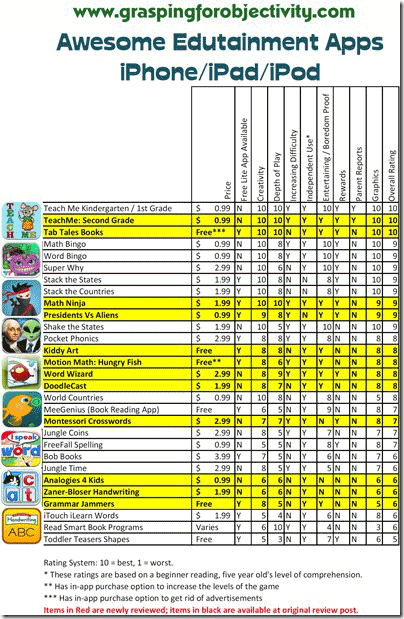
• Or sum up your post with a grid. This chart shows iOS apps I reviewed in April, but also ones I had previously reviewed in 2011.
•
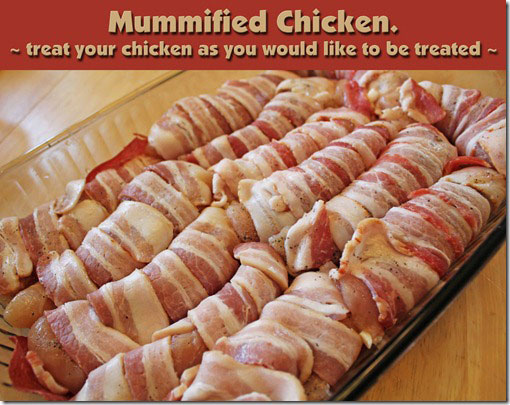
• Or add a catchphrase. This one added a humorous note to a recipe page for Mummified Chicken.
•
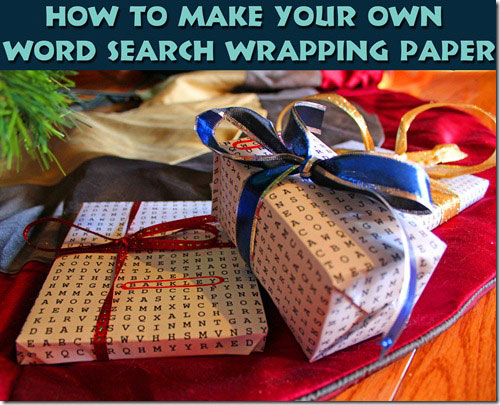
• Or simply explain it, so that the reader has no doubt as to what it is. Does it get much simpler than “How to Make Your Own Word Search Wrapping Paper”?
•
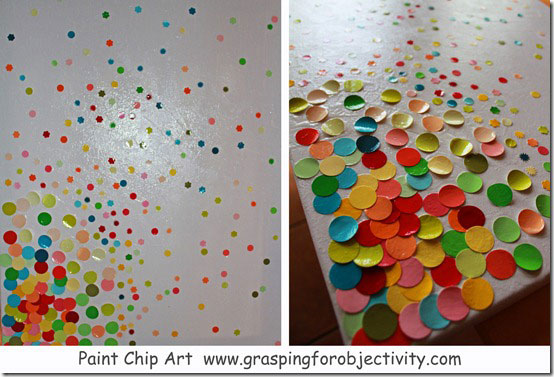
5. Cite your site. Even if your graphic needs very little explanation, make sure to include your URL, in case it becomes separated from your original post. (You can see I forgot to do so on several illustrations above.)
This photo was part of a series of steps for the kid-friendly Paint Chip Art project.
•
6. Use the Pin It button for websites. This button will help remind visitors to pin your stuff, as well as allow you to designate which image will be pinned. Test your button, and make sure it does what you want it to do!
7. Pin your own stuff. It never hurts to get the ball rolling, and it is totally appropriate to pin your own creations. Just make sure that you pin other people’s stuff, too, or you’ll lose your influence.
8. Buy Photoshop Elements. At only $64 on Amazon [aff. link], this tool (or one like it) will improve your ability and speed in editing photos and creating graphics.
Will your content go viral by using these tips? Not always: The above posts received a hundred or so pins each.
Remember, you must produce interesting, quality content. Once you do, good images can definitely help those posts command attention.
•
More from Rachel: Three hacks to access your site’s Pinterest statistics
• • •
Follow Rachel online …
How Cindy used Pinterest to land her dream job
I write posts here for one simple reason: to get me hired. Imagine my surprise when I found out one of my posts helps someone else find a job.
 Cindy Wincek was kind enough to share her insights into Pinterest, which I put into a post in January.
She emailed me last week with exciting news …
“I just wanted to thank you so much for the blog post you wrote about me and my Pinterest board, Don’t Hate the Players. Because of it, I actually landed my dream job. I am now the MLS account manager at 365 Inc.
“We run WorldSoccerShop.com and MLSGear.com, to mention a few sites. The CEO of the company was informed about me by someone who read your blog post. And the rest is history.
“Basically, I am in charge of managing MLSGear.com, the official online store for the MLS. I’ll get to travel to Manhattan to meet at MLS headquarters a few times a year and also go to various games. They are actually sending me to the MLS All-Stars vs. Chelsea FC (English Premiere League team and 2012 Champion’s League winner) in July in Chester, Pa.
“I am surrounded by soccer 24/7/365 now!”
That is awesome. Cindy is awesome! You the reader are awesome!
Cindy’s passion for soccer showed through on her popular Pinterest players board. Now she works for a Birmingham-based sports merchandise company. How is that not awesome?
Don’t ever stop blogging about the things that drive you forward. You never know when you’ll reach the right people with your passion.
• • •
I’d love to write about how you’re using social media.
Drop me a line so I can get started …
The perilous world of user feedback

Grocery IQ received hundreds of bad reviews after its latest app upgrade.
I love users, even when they don’t love me or my company back. They are an endless source of ideas, feedback and yes, even criticism.
I know plenty of people who hate users. They find them troublesome, whiny and a complete waste of time.
Which is it for you?
In either case, users give plenty of feedback on what we do right or wrong. Ignore that advice at your peril.
One of my favorite iPhone apps Grocery IQ found out the hard way. I’ve recommended this free app dozens of times to friends, because it was incredibly useful and rich in features. It stores your favorite supermarket items, and allows you to quickly build lists for your next grocery run.
Two of my favorite features:
- Customize the aisle layout by store. The trip to Publix is different from the one to Walmart. Getting the aisles in the right order makes for quicker shopping and scanning of my grocery list.
- Save favorite items for each store. I buy certain things over and over at Freshfully and other stores. But I can’t buy Diet Coke at Freshfully and I can’t get my cheap brand of peanuts at Publix. Having each store’s custom list makes it easier to plan and to shop.
Coupons.com, the owner of Grocery IQ, recently released version 2.6, which added features like scanning multiple barcodes and voice search. More notably, it also removed several features such as … customizing aisle layout and saving favorite items for each store. All that work? Gone.
It also removed a feature — one I didn’t even know existed — that stored item prices. Many other users kept track of them for household budgets and comparison shopping.
The feedback was immediate and deservedly harsh.
https://twitter.com/#!/ChrisMonty/status/201853432586452993
https://twitter.com/#!/johnwcorey/status/201389927466938368
On Facebook, the company fielded many complaints (part 1 | part 2), but to its credit, responded with updates and apologies.
However, in the iTunes app store, hundreds of 1-star ratings dropped the top-ranked app from a 4.5-star rating to a lowly 1.5-star rating. (My own review didn’t make it, probably because the headline I submitted was “Fucking terrible.”)
It’s important to note that in the iTunes store, Coupons.com can’t respond to the hundreds of complaints. It can only respond in the description of the next update, which the reviewers have even pounced on: “We are bummed that some of our changes in 2.6.0 inconvenienced our active users!”
The company has said it is restoring some of the missing features, but for many users, it’s too late. They’ve already switched to other apps after a seeming betrayal by Grocery IQ.
Did Coupons.com ask loyal users about features before the upgrade? Did it ignore that feedback? Can it recover from this setback? Does Coupons.com love its users, or does it see them as clicks on coupons and ads?
You can avoid this fiasco with a few steps.
- Ask for feedback from users. And not just once … all the time. You have more ways than ever: surveys, blog posts, social media, email, calls and focus groups.
- Listen. Really listen. I can’t tell you how many times I’ve conducted surveys for companies, only to have them go with their “gut” instead.
- Respond after the fact. Humble brands admit when things aren’t perfect and even concede when they make mistakes. Arrogant brands keep trumpeting how they’re helping the user, even as hundreds flee.
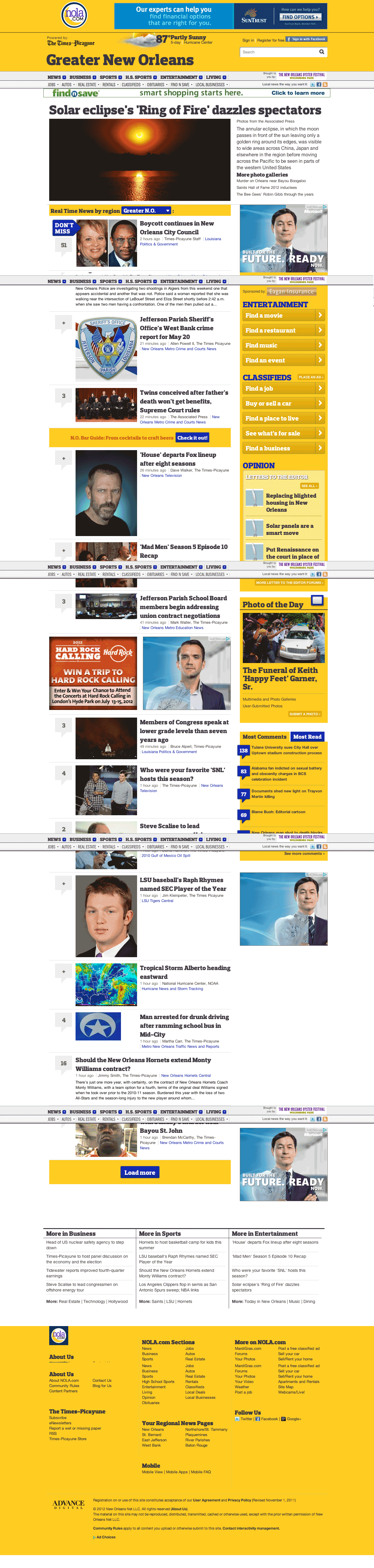
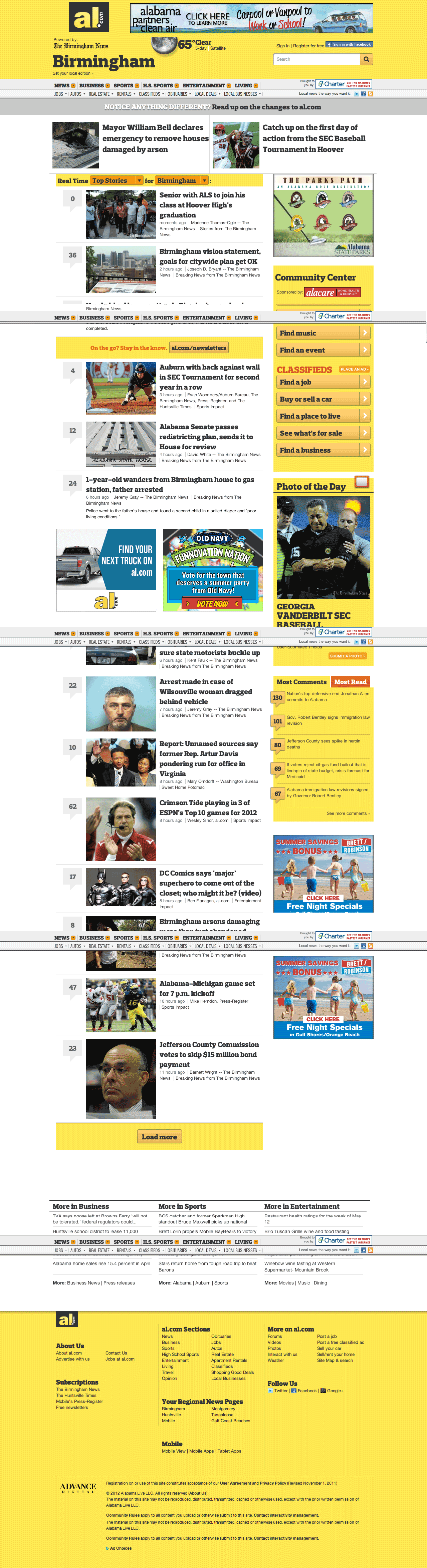
Your products and services will change over time, and not every user will love them. This week, Alabama’s largest website al.com will roll out a new design from the overlords at Advance Digital, which oversees a family of news sites across the country. When the same design came to New Orleans site nola.com, users left nearly 400 comments (plus more on Facebook).
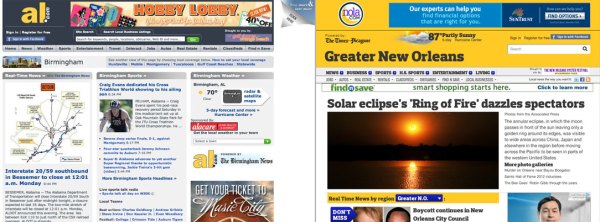
Left: al.com front page before 2012 makeover. Right: nola.com front page after makeover.
See full-size versions of the al.com front page and nola.com front page.
(And the newly redesigned al.com front page.)
It’s a top-down change as always, though the report says it’s “based on feedback from users, as well as an analysis of how visitors to the site access information and spend their time there.”
Early responses to the redesign were uniformly negative.
Does al.com and Advance love users? Or does it see them as loud-mouthed rabblers?
Love your users. Embrace them, and they will not lead you astray.
• • •
Need help finding out what your users want?
Contact me today for a free consultation.
When content machines go berserk

Content takes time, and good content takes significant time, and sharing good content takes even more time.
Clients often ask me, “How can I automate my social media updates?” in an effort to save precious time. I’ve warned them that such time-saving measures can backfire.
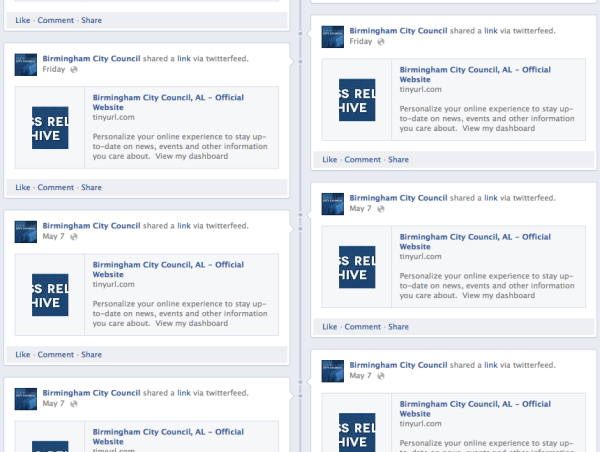
For example, the Birmingham city council paid $8,900 in 2010 to have its own website, birminghamalcitycouncil.org, in addition to the one already available for city government.
Every new post or calendar item is automatically shared on the council’s new Facebook and Twitter channels, presumably set up by the website’s template builder, CivicPlus.
•
Look at the valuable information shared on the council’s Facebook page …
•
And on the council’s Twitter account @CC_Birmingham …

•
It’s not that thousands of companies and organization do this (and worse) — it’s that I and other Birmingham residents paid for this poorly executed content monster with tax dollars.
I won’t bother with an extensive website critique, but in my esteemed opinion … it’s pretty sucky.
The simplest formula for communicating successfully online with an audience is …
- Make and post great content.
- Share it with your audiences in a deliberate and thoughtful fashion.
- Repeat.
I hope I saved you $8,900 and the embarrassment of using a content machine gone berserk.
- Other CivicPlus sites for comparison
- When the Birmingham city council looked outside the area for help
• • •
Want to learn more about social media without leaving your Inbox?
Sign up for our e-newsletter today!

Freshfully co-founder Jen Barnett, with Wade Kwon
Some 23 years ago, I held my only job at a supermarket, as a part-time bagger. It was great: The work was easy, and the money I saved went to buying my first Mac.
Great … until I came down with meningitis. Thus ended my short career (and very nearly short life) in groceries.
Last week, that other path had a brief resurgence, as I stepped in as a volunteer for the new Freshfully market in Birmingham. One of the co-founders is Birmingham Blogging Academy co-conspirator Jen Barnett.
I have relied on Jen’s expertise in marketing for many years, so it was a pleasure to take part in the grand opening celebration of her new grocery store in Avondale. In the full week I worked, we saw a steady stream of happy customers and well-wishers from all parts of town. It is the culmination of years of hard work by her and her business partner, Sam Brasseale.
Being back in the retail sector, even for this brief period, reminded me of how important it is to be open with the community and the customers. I saw old friends and made new ones just opening the door over and over for people entering or exiting.
I quickly noted what items were flying off the shelves, and which ones needed a nudge. My brain lit up with all kinds of ways to promote the store, whether through a personal recommendation or an ad campaign.
And I saw the power of stories again and again. No matter how crazy busy the shop became, the story essentially remained the same: Happy people selling local food.
Your business needs a great story. With it, almost anything is possible.
•
1. Great stories dig deep into content. Freshfully shares a little bit of its story every day. And it’s an amazing story.
You can find new chapters on its blog, its Facebook page, its Twitter page, its Pinterest page, its Instagram photos and in person at the shop. This is a crash course in content marketing.
Fans learn when peaches arrive, when tomatoes are about to run out (or have run out), who Farmers James and Wayne are, how to prepare kale and how the ground beef came to be. The more I worked, the more stories I learned to share with people browsing the aisles: We sold 250 pounds of tomatoes yesterday, but more are on the way; those squash arrived an hour ago; that cooler has box lunches made this morning at Chez Lulu.
Ask a question about an item, and you’ll hear a tale of who made it and why it was picked for sale.
Takeaway: Know your company, your products and your services, and turn it into an interesting narrative for fans, customers and strangers.
•
2. Great stories get covered by the media. Jen and Sam won a contest to start its Freshfully website. They won a second contest to earn the retail location with 6 months’ free rent. They opened the store in barely a month.
Any one of those items is a great story unto itself. And all of them have been covered thoroughly by television, radio, newspapers, magazines and blogs.
Freshfully sends out media releases on a regular basis, but the company does not need to work nearly as hard as other companies to get coverage. Waves of publicity send curious people to the door, who told me how they learned about the new grocery store.
They might not have purchased a single thing that day, but they left knowing what was available, how much it cost and when to come back (10 a.m. to 7 p.m. 7 days a week).
Takeaway: Tell the media (including bloggers!) regularly about the latest scoops inside your walls. And when they call, always answer: Reporters love business owners who help them on deadline.
•
3. Great stories are shared by the people. See someone taking a photo or a video in a store, and the clerks might become suspicious. At Freshfully, those nosy shoppers are the cheerleaders and the respected peers who help make the store a little more open, a little more trusted.
I wrote about my first day on the job at Wade on Birmingham using Storify, a tool that makes it easy to find and curate what people are sharing online. That includes photos, blog posts, Foursquare check-ins, videos, Facebook updates and albums, tweets and RSS feeds.
That post includes 16 photos taken by Birminghamians, shooting to share for their own audiences, not for a magazine or a newspaper or a book. These lovely shots of lettuce, Wickles Relish, cookies, eggs and the ribbon cutting were all part of the Thursday’s stream of information.
And they represent a fraction of all the updates shared, but collectively they, too, tell the story as seen through the eyes of moms, reporters, neighbors, vendors and office workers. It’s not a question of if people are sharing your story on social media, but how thoroughly they are and if you’re rewarding them. (Though some of you are getting no online love at all.)
Takeaway: Listen carefully to what people are saying about you and to you, whether in person or online. And then, respond graciously and kindly, even to the most scornful of the lot.
4. Great stories have twists and turns. Opening week of any store is fraught with peril …
- No produce has arrived, and the doors open in 20 minutes.
- A staffer is in tremendous pain and can’t make it in this morning.
- The receipt printer is lagging some 20 minutes behind actual checkout.
- Some guy is wandering around with what appears to be a duck puppet (the other clerks swore this happened while I was there).
- The salsa lady arrives for her demo right after all the jars have been sold.
- Two TV camera crews and a newspaper photographer arrive around the same time.
- Shoppers are flooding the store, and we’re out of half the produce, all the box lunches and most of the quarters.
Freshfully’s opening week went smoothly, because it has a great staff and a great attitude about helping people. But that doesn’t mean everything went without problems big and small. It happens.
What is the most important difference between companies that succeed or fail when each one faces these setbacks?
The organizations leading the revolution are slavishly devoted to people. They care so deeply that they’ll invite them to help write the story. Several cyclists who dropped by requested a bike rack (and one even suggested where to find one locally). A small spiral notebook and a pen are on the checkout counter, asking visitors what items Freshfully should carry next.
Children receive stickers and hugs with a giant stuffed carrot. Fans ask questions and share suggestions on the Facebook wall. Lost diners are pointed in the direction of the still unmarked Saw’s Soul Kitchen across the street.
It is ultimately the customers who decide how this story ends. Retailers can either shut their eyes and plug their ears, or they can hand out pens and paper with a smile.
Takeaway: The great brands aren’t ones that make zero mistakes. The great brands show how their mistakes lead to better products, stronger customer service and an outstanding experience. Don’t just share your story — share control of your story with your customers.
•
A great story can make a company profitable, can help it stand out among competitors, can inspire people to spread the word. Build something fantastic, tell that story, and make it easy for others to chime in.
Freshfully may look like an ordinary website and a grocery store, but those who’ve “read the book” are already immersed in its page-turning, thrilling adventure.
- Wade on Birmingham: “My day at Freshfully”
Photo: Jessica Bush
• • •
Need help with telling your story to your customers
and the media? Contact me today for a free consultation.
VIDEO: How to network gracefully
Some tips on networking, to help your career and freelancing, and to help others. Plus, a tip for introverts.
• • •
Want to learn more about social media without leaving your Inbox?
Sign up for our e-newsletter today!


 Birmingham Blogging Academy